Thursday, October 27, 2016

The river was expected to furnish its daily quota ... Jules Verne, Eight Hundred Leagues On The Amazon

The river was expected to furnish its daily quota; prawns, which ought rather to be called crawfish; "tambagus," the finest fish in the district, of a flavor superior to that of salmon, to which it is often compared; "pirarucus" with red scales, as large as sturgeons, which when salted are used in great quantities throughout Brazil; “candirus,” awkward to capture, but good to eat; “piranhas,” or devil-fish, striped with red bands, and thirty inches long; turtles large and small, which are counted by millions, and form so large a part of the food of the natives; some of every one of these things it was hoped would figure in turn on the tables of the master and his men.

From Eight Hundred Leagues On The Amazon (1881) by Jules Verne

Fish market at Porto da Ceasa, Manaus, Brazil


The ordinary traveller, who never goes off the beaten route and who on this beaten route ... does not need to show much more initiative and intelligence than an express package - T Roosevelt

Manaus
We must not fall into the foolish error of thinking that the first explorers need not suffer terrible hardships, merely because the ordinary travellers, and even the settlers who come after them, do not have to endure such danger, privation, and wearing fatigue — although the first among the genuine settlers also have to undergo exceedingly trying experiences. The early explorers and adventurers make fairly well-beaten trails at heavy cost to themselves. Ordinary travellers, with little discomfort and no danger, can then traverse these trails; but it is incumbent on them neither to boast of their own experiences nor to misjudge the efforts of the pioneers be cause, thanks to these very efforts, their own lines fall in pleasant places. The ordinary traveller, who never goes off the beaten route and who on this beaten route is carried by others, without himself doing anything or risking anything, does not need to show much more initiative and intelligence than an express package. He does nothing; others do all the work, show all the forethought, take all the risk—and are entitled to all the credit. He and his valise are carried in practically the same fashion; and for each the achievement stands about on the same plane. If this kind of traveller is a writer, he can of course do admirable work, work of the highest value; but the value comes because he is a writer and observer, not because of any particular credit that attaches to him as a traveller. pp. 171-72

From Through the Brazilian wilderness (1914) by Theodore Roosevelt

Nevertheless, tempting as was the prospect of a visit to Brazil, as a mere vacation it had little charm for me - EC & L Ag

Meeting of the Waters
Nevertheless, tempting as was the prospect of a visit to Brazil, as a mere vacation it had little charm for me. Single-handed, I could make slight use of the opportunities I should have; and though the excursion might be a pleasant one for myself, it would have no important result for science. p.v-vii.

* * * * *

The voyage on the Amazons proper has now become accessible to all who are willing to endure heat and mosquitoes for the sake of seeing the greatest river in the world, and the magnificent tropical vegetation along its shores. The best season for the journey is from the close of June to the middle of November, July, August, September, and October being the four driest months of the year, and the most salubrious throughout that region. p. 444

From A Journey in Brazil  (1868) by Elizabeth Cabot Agassiz and Louis Agassiz

"Some far land where endless summer reigns" - Alfred Russel Wallace #QotD

Manaus Airport
An earnest desire to visit a tropical country, to behold the luxuriance of animal and vegetable life said to exist there, and to see with my own eyes all those wonders which I had so much delighted to read of in the narratives of travellers, were the motives that induced me to break through the trammels of business and the ties of home, and start for "Some far land where endless summer reigns." p. xi

* * * * *

I informed him, however, that I was a "Naturalista," and wanted birds, insects, and other animals; and then he began to comprehend, and at last promised to send me some men the day after the next, to carry over my luggage. I accordingly turned back without going to the village, which was still nearly a mile off.  pp. 167-68

From A narrative of travels on the Amazon and Rio Negro by Alfred Russel Wallace (1853) (1889 ed)

Parana do Mamori


Wednesday, October 26, 2016

Winners of the Ebbe Nielsen Challenge / presented by @RDMPage #GB23

GBIF 23 Public Symposium

Winners of the Ebbe Nielsen Challenge (presented by Rod Page)

Following the success of the first Ebbe Nielsen Challenge (won by the entry “GBIF dataset metrics” created by Peter Desmet, Bart Aelterman & Nicolas Noé from Belgium) we have launched a second Challenge. This time the challenge is focused on addressing the issue of “gaps and biases in primary biodiversity data”, a topic flagged as being important in the Science Committee report presented at GB 22. See the challenge website.

Honorable Mentions

  • Crowdgap
  • BioGeoBias
  • Towards global-scale species distribution models

Second Prize

  • GBIF Coverage Assessment Tools
  • Sampbias

First Prize

  • Exploring ignorance in space and time


@GBIF 's Priorities and Direction for 2017-2021: Panel 2 #GB23

GBIF 23 Public Symposium

GBIF's Priorities and Direction for 201-2021: Panel 2

Donald Hobern (GBIF Executive Secretary) gave a number of highight from the 2017 Implementation plan. GBIF's role is:

  • Remove obstacles to collaboration in sharing and use of biodiversity data
  • Organize evidence of recorded occurrence of any species in time and space
  • Support development of a global virtual natural history collection

He also outlined the five priorities for 2017-2021 and focused on key elements:
  • Strengthening skills of GBIF participants and the biodiversity community, this includes providing skill sets to new GBIF heads of delegation and node managers
  • Fill data gaps; GBIF needs to identify data sets that appear outside of normal GBIF ingests; what are the technical requirements to make this happen?
  • Support biodiversity assessment; identify the key data variables needed to model biodiversity
Greg Riccardi (iDigBio | U.S.) spoke on mobilizing collections and collections digitization infrastructure in the U.S.; Rui Figueira (Portugal) discussed delivering relevent data, specifically using agrobiodiversity as an example; Néstor Acosta (Ecuador) gave an engaging talk from the perspective of a new GBIF participant. 

Scaling up capacity enhancement, #GB23 panel

Raymond, Escobar, Radji, Heughebart, Wang

GBIF 23 Public Symposium

Scaling up capacity enhancement: BID, BIFA and supplementary funding: Panel 1

Mélianie Raymond (GBIF Secretariat) led a panel about capacity enhancement being done by GBIF. Challenges include expanding network of countries, institutions, and people; rapidly evolving tools and processes; and a small Secretariat team. Raymond then outlined the two key funding tools (BID and BIFA), as well as supplementary funding.

Other panelists were Pierre Radji (Togo), Yu-Huang Wang (TaiBIF), and Dairo Escobar (Colombia). Panelists spoke specifically on how capacity buildg worked in their region or country. André Heughebart (Belgium) provided a view from a mentor.

Friday, September 30, 2016

Brief report from the National Digital Stewardship Residency: Opening Conference #NDSR

Carla Hayden
On 29 September 2016, along with Carolyn Sheffield (BHL Program Manager), I attended the NDSR Opening Conference at the Library of Congress.

The purpose of the half-day conference was to reflect on the NDSR and to welcome the 2016-2017 class of Residents.

The meeting opened with a welcome talk from Carla Hayden, the recently sworn in Librarian of Congress. George Coulbourne (Chief, Intern and Fellowships Programs, Library of Congress) and Mary Alice Ball (Intern and Fellowships Programs, Library of Congress) chaired the meeting. Coulborrne followed Hayden with some opening remarks about the NDSR program and it's relation ship with the Library of Congress. Colleen Shogan (Deputy Director, National & International Outreach, Library of Congress) followed with a talk on "Innovation and Mentorship" and how that related to the work done by the NDSR residents and their mentors.


(left to right: Shogan, Ball, Coulbourne)

Nancy Weiss (General Counsel, IMLS, left) spoke on "Enhancing Digital Services Nationally". The NDSR program is funded through the IMLS. Weiss looked both back (to the past work of IMLS in funding the NDSR program) and forward, noting that next year's program will include a major project working with the Biodiversity Heritage Library.

The event was also attended by alums from the NDSR program from over the years and the audience had a chance to recognize them.

The keynote speaker for the event was from Winston Tabb (Sheridan Dean, University Libraries and Museums, Johns Hopkins University). Tabb gave an outstanding talk that looked back to the role of digitization, digital libraries, and digital preservation has changed over the past 20-25 years.

Winston Tabb

The meeting concluded with two reflections. The first, from Karen Paul (Chief Archivist, U.S. Senate Historical Office); and the second from John Caldwell (Archivist, Office of the U.S. Senator Harry Reid). Paul's perspective was that as a mentor and NDSR host; Caldwell spoke as a former NDSR resident and offered some hints and advice to the incoming cohort.

Caldwell

Paul

Monday, September 26, 2016

Stressors and Drivers of Food Security: Evidence from Scientific Collections #SciCollFood

Stressors and Drivers of Food Security: Evidence from Scientific Collections
19-21 September 2016
National Agriculture Library, Beltsville, MD
Hosted by: U.S. Department of Agriculture

The Stressors and Drivers of Food Security: Evidence from Scientific Collections workshop was organized by Scientific Collections International (SciColl) at the National Agriculture Library in Beltsville, Maryland, 19-21 September 2016. The SciColl mission is "Increase the use and impact of scientific collections for interdisciplinary research and societal benefits. Expand the access, awareness and appreciation of scientific collections" and the "Stressors and Drivers of Food Security" workshop was designed to help show the importance of scientific collections to the topic of food security.

Wester
The first day opened with welcomes from Paul Wester, Director of the National Agriculture Library and Catherine Woteki, Under Secretary for Research, Education, and Economics at the US Department of Agriculture. David Schindel (Chairman, SciColl Executive Board) then gave an overview of SciColl to the approximately 40 attendees from around the world.

Two keynote talks followed. The first, from David Inouye (Professor Emeritus at the University of Maryland and Principal Investigator at the Rocky Mountain Biological Laboratory) covered the importance of collections and field studies of pollinators in fostering food security. Kristen Gremillion (Professor at the Ohio State University) on the fascinating topic of ancient crops, archaeological collections, and food security.

The keynotes were followed by a series of short talks from:
Grace Costantino from the Biodiversity Heritage Library gave a talk entitled "Literature Resources to Support Food Security Research: An Introduction to the BHL".

Kalfatovic
The second day of the meeting was focused on four sessions devoted to presentations about different research challenges, followed by commentaries and discussion by panelists representing different collection domains. The focus will be on how different collection types could contribute to research.

I chaired the first session, "Varieties of Food," that featured talks from Rod Page (University of Glasgow), "Unknown Knowns, Long Tails, and Long Data", and Ari Novy (Director, US Botanic Garden). The session was followed by comments from a reactor panel and discussion from the audience. The remaining sessions followed a similar format with reactor panels and audience discussion.

Biological Stressors and Aides
  • Kevin McCluskey, Kansas State University
  • Marcia Maués, Embrapa 
Environmental Stressors and Benefits
Feeding the 10 Billion
The closing day of the workshop was devoted to developing new strategies and discussing next steps. Breakout groups were organized to discuss the following topics:
  • New strategies for increasing the use and impact of collections and associated databases for food security research
  • Case studies that exemplify cross-cutting and forward-thinking uses of collections and associated databases for food security research
  • Major recommendations for the research and collections communities, funding agencies, and/or networks (such as SciColl)
The results of the workshop will be published later this year in a white paper. The video recordings of the workshop are available on the SciColl YouTube channel.

More information:


Thursday, September 15, 2016

Tuesday, September 13, 2016

Report on the ICSTI 2016 General Assembly & Workshops

IMG_20160910_094921

The International Council for Scientific and Technical Information (ICSTI) 2016 General Assembly & Workshops

Denver | 10 September 2016 | Twitter Stream


On 10 September 2016 I attended the ICSTI 2016 General Assembly & Workshops in Denver with Suzanne Pilsk on behalf of Smithsonian Libraries.  ICSTI 2016 General Assembly was held in Denver to take advantage of the International Data Week meetings being held the following week.

The Member Initiative Presentations followed a brief business meeting.

Smithsonian Libraries were invited to present during the Member Initiatives session on the topic of Smithsonian Research Online and activities around that including the Public Access Mandate and the implementation of Smithsonian Profiles. Suzanne Pilsk wrote and delivered the presentation on behalf of SIL,

The other Member Initiative talks were by:
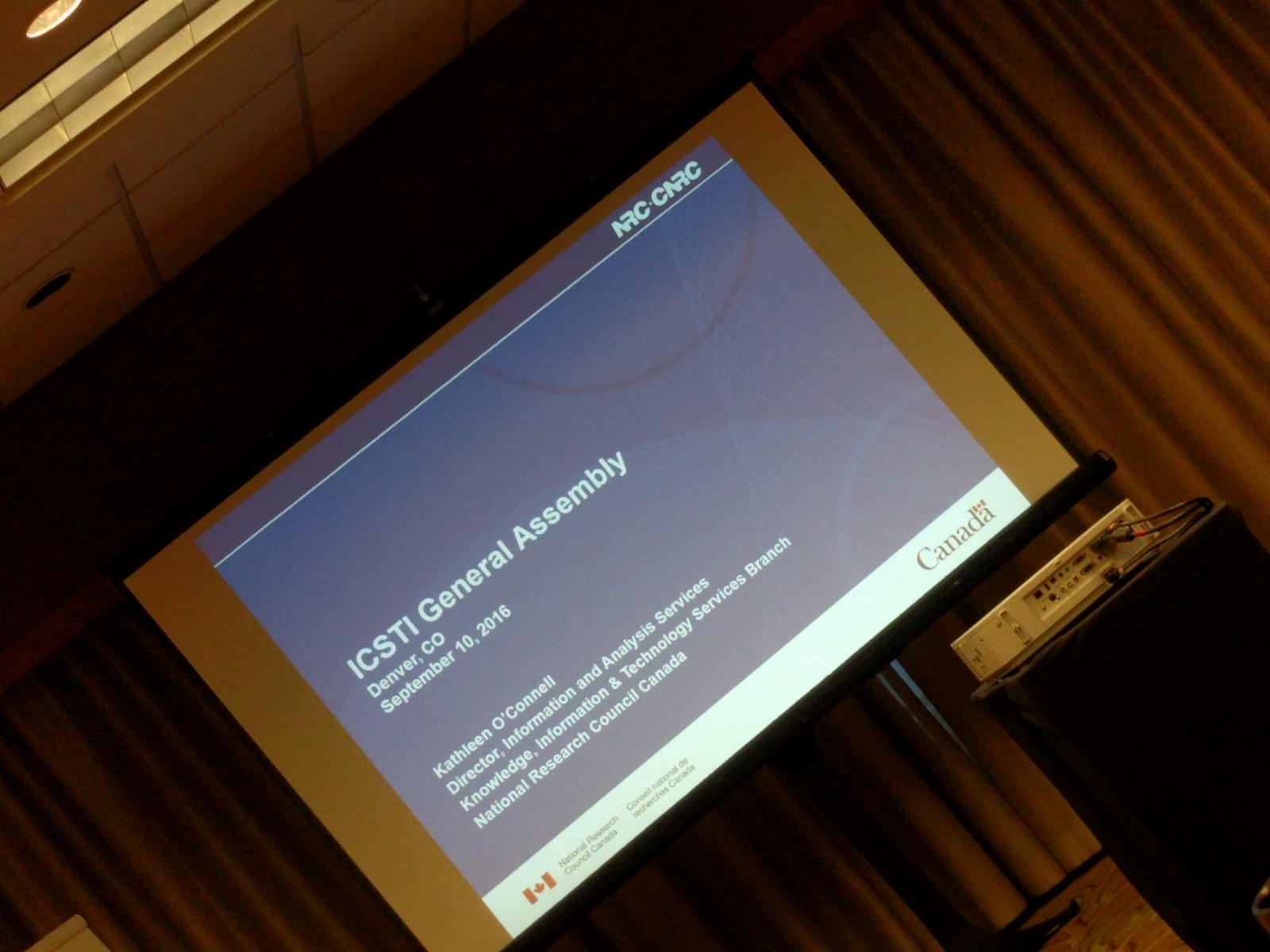
  • Kathleen O'Connell (National Research Council Canada)
  • Mustapha Mokrane (Inferential Council for Science on World Data Systems)
  • Tae-Sui Seo (Korea Institute of Science and Technology Information)
IMG_20160910_102427 IMG_20160910_101130 IMG_20160910_104347
(from left: Pilsk, Mokrane, Seo)

These talks were followed by two workshops:
  • Information Trends and Opportunities Committee (ITOC) Workshop 
  • Technical Activities Coordinating Committee (TACC) Workshop 


Information Trends and Opportunities Committee (ITOC) Workshop 
Enabling Innovations for Researcher Workflows and Scholarly Communication
"The Information Trends and Opportunities Committee (ITOC) is the catalyst for strategic thinking of ICSTI. It conducts foresight/horizon scanning to identify trends and opportunities of interest and relevance to ICSTI members. The Chair of ITOC is Margret Plank, Head of Competence Center for non-textual Materials at the German National Library of Science and Technology (TIB)."

Jeroen Bosman and Bianca Kramer (Utrecht University Library/101 Innovations in Scholarly Communication). Innovations in scholarly communication: openness, efficiency and reproducibility drivers.
  • For those of you who may not yet have looked at the 101 Innovations in Scholarly Communication project, it is worth your time. The project provides a valuable empirical underpinning from a survey of over 20,000 researchers on just how the core nature of scientific communication is changing.
Cameron Neylon (Force 11). From Principles to Action - The FORCE11 approach to innovation in scholarly communications. 
  • "FORCE11 started as a movement for change amongst a particular group of technically minded people in scholarly communication including publishers, technologists, researchers, advocates and funders. Over time it has evolved in a number of directions, now positioning itself as a forum where different stakeholder communities can come together to seek a consensus on how to move forward. In particular a pattern has emerged in which successful groups seek first to articulate and refine a set of principles that can help to guide implementation but do not specify it. If a wide consensus can be developed on principles then the next phase moves towards community implementation. The success and challenges of this approach will be discussed with examples."
Lambert Heller (German National Library of Science and Technology (TIB)). Wikidata and Wikimedia Commons as a platform for collaborative annotation and reuse for scientific data. 
  • Excellent talk about the use/re-use of Open Access literature within WikiSource.
Courtney Soderberg (COS, Center for Open Science). An Open Science Framework for managing and sharing research workflows. 
  • Soderberg's talk was an excellent and engaging discussion of the mission of the Center for Open Science (COS). COS's remit is to increase openness, reproducibility, and integrity of scholarly research.
Alex Viggio (University of Colorado Boulder). Lessons Learned from the OpenVIVO Experiment.
  • Very interesting overview of the OpenVIVO experiment. OpenVIVO is hosted version of the VIVO software (which runs Smithsonian Profiles) to which any researcher around the world can enter their own profile.

IMG_20160910_124210 IMG_20160910_122342 IMG_20160910_120904
(from left: Viggio, Soderberg, Heller)


Technical Activities Coordinating Committee (TACC) Workshop 
Trends in Scientific Software Development, Sharing, and Use
ICSTI’s Technical Activities Coordinating Committee (TACC) typically focuses on exploring and communicating technical aspects of innovative trends in information science-based tools that help make STI more useable and accessible. The Chair of TACC is Brian Hitson, Director US DOE/Office of Scientific and Technical Information (DOE/OSTI).

Jay Billings (Oak Ridge National Laboratory & DOE Office of Scientific and Technical Information). The New Department of Energy Software Center
  • Billings discussed the DOE's Software Center, why such a center is needed, and ongoing development efforts.
Andrea Ross (Eclipse Foundation). Eclipse Foundation: A symphony of R&D collaboration
  • Ross gave a fascinating talk about the Eclipse Foundation and its efforts to nurture a community of software developers collaborating on a massive scale to develop high quality software.
James Willenbring (Sandia National Laboratories). The IDEAS Scientific Software Productivity Project
  • The Interoperable Design of Extreme-scale Application Software (IDEAS Project is a collaborative project of the seven national labs, a university, and three major computing facilities. "A key deliverable of the IDEAS Project is the Extreme-scale Scientific Software Development Kit (xSDK), which strives to provide the foundation for an extensible scientific software ecosystem, with components developed by diverse, independent teams throughout the high-performance computing community."
Fernando Pérez (Lawrence Berkeley National Laboratory). Project Jupyter: from interactive data science to reproducible computing in HPC environments
  • "Project Jupyter is a language-agnostic platform for scientific computing and data science that is widely used in research, education and industry. It evolved from the original IPython project, an interactive shell for the Python programming language, as the ideas in IPython were generalized to represent interactive computational processes in any language."
Eleonora Presani (Elsevier). SoftwareX – A new Open Access software journal
  • Presani's talk, on the multidisciplinary SoftwareX journal was a fascinating discussion of ways to document and create a scholarly communication dialog around a deliverable product (sofware). Post talk discussion include some compare/contrast to Journal of Open Source Software
IMG_20160910_141001 IMG_20160910_142858 IMG_20160910_150132
(from left: Billings, Ross, Willenbring)