Showing posts with label ICSTI. Show all posts

Monday, November 13, 2017

International Council for Scientific and Technical Information (ICSTI) 2017 General Assembly & Workshops (Washington)

Jan Brase (President) & Tony Llewellyn (Executive Director)

International Council for Scientific and Technical Information (ICSTI) 2017 General Assembly & Workshops (Washington)


Along with Smithsonian Libraries' Director Nancy E. Gwinn, I attended the International Council for Scientific and Technical Information (ICSTI) 2017 General Assembly & Workshops on 26 October 2017 at the Library of Congress.

Smithsonian Libraries and the Biodiversity Heritage Library are participants in ICSTI and benefit from working in the wider community of scientific and technical communities. ICSTI meetings are comprised of a General Assembly with a business and presentation session, the Technical Activities Coordinating Committee (TACC) Workshop, and the Technical Activities Coordinating Committee (TACC) Workshop. The latter two sessions form the core of the meeting and provide opportunities to learn from a wider, global community.

The full program and links to presentations can be found here.

GENERAL ASSEMBLY

Donna Sheeder
After a business meeting, there were presentation by ICSTI Members. This meeting's talks included:

  • Donna Sheeder – IFLA: Her talk focused on the some key IFLA initiatives : IFA’s international advocacy program for Access to information through Libraries as critical to the achievement of the the UN Sustainable Development Goals, IFLA’s global vision program, and the Library Map of the World.
  • Regina Romano Reynolds – ISSN: Regina provided an overview of the ISSN Network’s strategy to provide enhanced access to ISSN (International Standard Serial Number) data will include plans for enhancing the ISSN International Centre’s operations, infrastructure, data, products and services, communications, and partnerships. 
  • Tomoko Steen – Library of Congress: Tomoko’s short presentation introduced LC’s new approach to digital preservation of rare and historical materials at the Library of Congress and other digital initiatives with some examples.

Ray Shan

Technical Activities Coordinating Committee (TACC) Workshop

Machine Learning and Its Applications to Scientific and Technical Information
Machine learning may be the next great innovation in knowledge search and discovery. Machine learning describes what happens in machines that get trained to perform a task by exposure to examples of what they’re supposed to learn. It’s already happening all around us in the development of facial and object recognition ; self-driving cars ; instant language translation ; and speech recognition. This workshop will explore machine learning and its applications relevant to science and, more specifically, to various forms of scientific and technical information, including images, data, and text.


  • Lee Angelelli, IBM. Applying Cognitive Computing to Understand and Answer Users Information Needs
  • Andrew Fast, CounterFlow AI. A Brief History of Machine Learning
  • Andrew McCallum, University of Massachusetts. AI for Representation and Reasoning in Knowledge Bases of Science
  • Ray Shan, Yewno. Using AI to Enhance Research
  • Georgia Tourassi, Oak Ridge National Laboratory. Deep Learning Enabled National Cancer Surveillance
Tomoko Steen

Information Trends and Opportunities Committee (ITOC) Workshop


Enhanced Publications: Approaches to Maximising the Value of Digital Assets to Enhance Scientific Publications
Current research is presented by a variety of digital assets. Besides text research also includes visualized research data, video, graphics, models and even software code. These digital assets are an important element of contemporary scientific outputs and thus part of our cultural heritage. Unfortunately, no sustainable standard has become established for handling these important assets. Only a negligible proportion of those digital assets are accessible at present, whilst scientific texts are, in principle, sufficiently well-documented and available. This can lead to serious problems when it comes to verify, reproduce and reuse the research results. In this workshop we’d like to focus on approaches and strategies for integration, re-use and re-purposing of data and digital content within scientific publications.

  • Neil Chue Hong, Software Sustainability Institute - Software - a different type of research object? 
  • Maarten Cleeren, Elsevier - Elsevier: Elsevier’s Article of the Future 
  • Markus Kaindl, Springer Nature - Springer Nature SciGraph – Building a Linked Data Knowledge Graph for the scholarly publishing domain 
  • Marco Stella, JoVE - Our Shared Role in Solving Science’s Reproducibility Crisis

Tuesday, September 13, 2016

Report on the ICSTI 2016 General Assembly & Workshops

IMG_20160910_094921

The International Council for Scientific and Technical Information (ICSTI) 2016 General Assembly & Workshops

Denver | 10 September 2016 | Twitter Stream


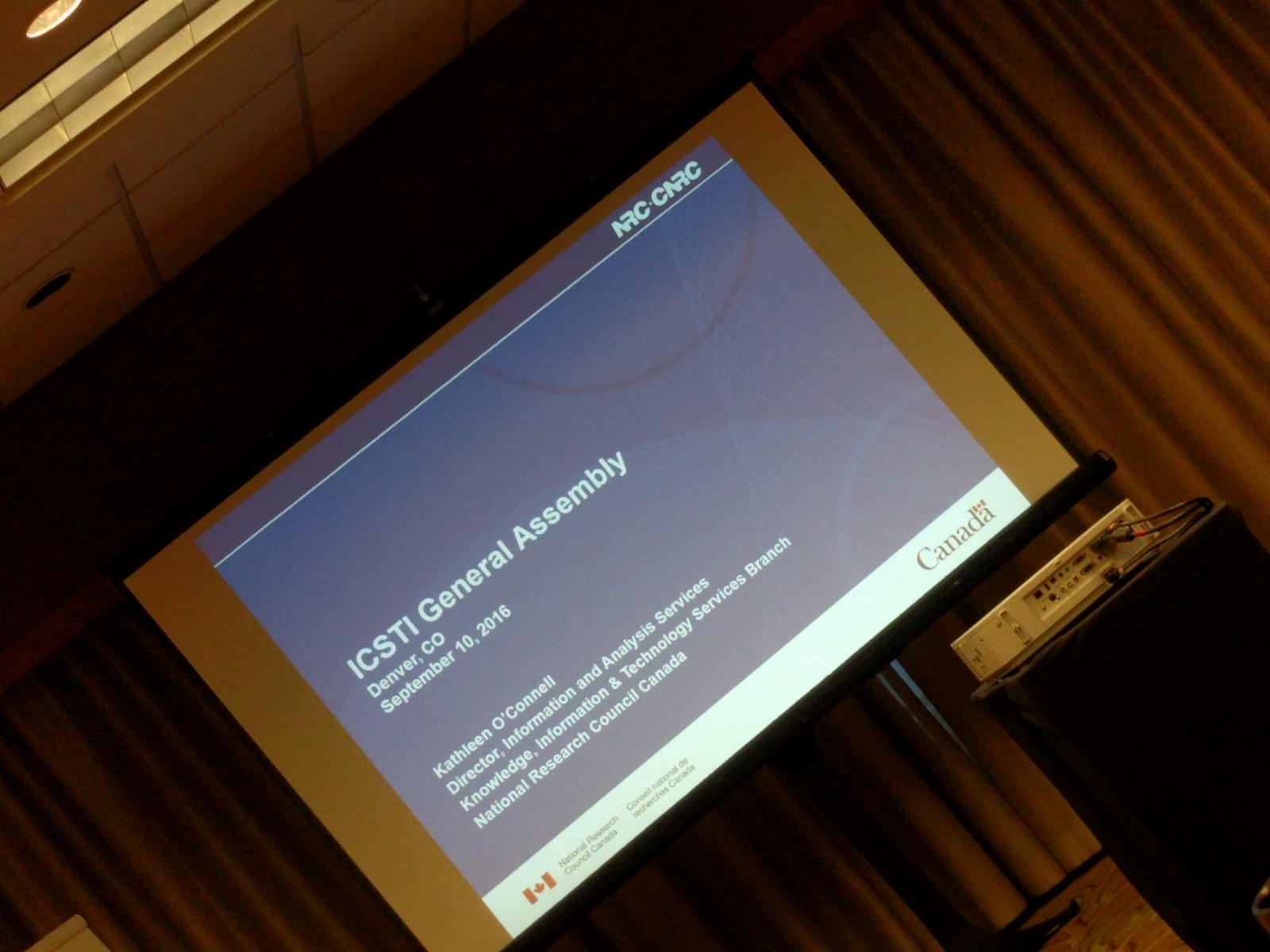
On 10 September 2016 I attended the ICSTI 2016 General Assembly & Workshops in Denver with Suzanne Pilsk on behalf of Smithsonian Libraries.  ICSTI 2016 General Assembly was held in Denver to take advantage of the International Data Week meetings being held the following week.

The Member Initiative Presentations followed a brief business meeting.

Smithsonian Libraries were invited to present during the Member Initiatives session on the topic of Smithsonian Research Online and activities around that including the Public Access Mandate and the implementation of Smithsonian Profiles. Suzanne Pilsk wrote and delivered the presentation on behalf of SIL,

The other Member Initiative talks were by:
  • Kathleen O'Connell (National Research Council Canada)
  • Mustapha Mokrane (Inferential Council for Science on World Data Systems)
  • Tae-Sui Seo (Korea Institute of Science and Technology Information)
IMG_20160910_102427 IMG_20160910_101130 IMG_20160910_104347
(from left: Pilsk, Mokrane, Seo)

These talks were followed by two workshops:
  • Information Trends and Opportunities Committee (ITOC) Workshop 
  • Technical Activities Coordinating Committee (TACC) Workshop 


Information Trends and Opportunities Committee (ITOC) Workshop 
Enabling Innovations for Researcher Workflows and Scholarly Communication
"The Information Trends and Opportunities Committee (ITOC) is the catalyst for strategic thinking of ICSTI. It conducts foresight/horizon scanning to identify trends and opportunities of interest and relevance to ICSTI members. The Chair of ITOC is Margret Plank, Head of Competence Center for non-textual Materials at the German National Library of Science and Technology (TIB)."

Jeroen Bosman and Bianca Kramer (Utrecht University Library/101 Innovations in Scholarly Communication). Innovations in scholarly communication: openness, efficiency and reproducibility drivers.
  • For those of you who may not yet have looked at the 101 Innovations in Scholarly Communication project, it is worth your time. The project provides a valuable empirical underpinning from a survey of over 20,000 researchers on just how the core nature of scientific communication is changing.
Cameron Neylon (Force 11). From Principles to Action - The FORCE11 approach to innovation in scholarly communications. 
  • "FORCE11 started as a movement for change amongst a particular group of technically minded people in scholarly communication including publishers, technologists, researchers, advocates and funders. Over time it has evolved in a number of directions, now positioning itself as a forum where different stakeholder communities can come together to seek a consensus on how to move forward. In particular a pattern has emerged in which successful groups seek first to articulate and refine a set of principles that can help to guide implementation but do not specify it. If a wide consensus can be developed on principles then the next phase moves towards community implementation. The success and challenges of this approach will be discussed with examples."
Lambert Heller (German National Library of Science and Technology (TIB)). Wikidata and Wikimedia Commons as a platform for collaborative annotation and reuse for scientific data. 
  • Excellent talk about the use/re-use of Open Access literature within WikiSource.
Courtney Soderberg (COS, Center for Open Science). An Open Science Framework for managing and sharing research workflows. 
  • Soderberg's talk was an excellent and engaging discussion of the mission of the Center for Open Science (COS). COS's remit is to increase openness, reproducibility, and integrity of scholarly research.
Alex Viggio (University of Colorado Boulder). Lessons Learned from the OpenVIVO Experiment.
  • Very interesting overview of the OpenVIVO experiment. OpenVIVO is hosted version of the VIVO software (which runs Smithsonian Profiles) to which any researcher around the world can enter their own profile.

IMG_20160910_124210 IMG_20160910_122342 IMG_20160910_120904
(from left: Viggio, Soderberg, Heller)


Technical Activities Coordinating Committee (TACC) Workshop 
Trends in Scientific Software Development, Sharing, and Use
ICSTI’s Technical Activities Coordinating Committee (TACC) typically focuses on exploring and communicating technical aspects of innovative trends in information science-based tools that help make STI more useable and accessible. The Chair of TACC is Brian Hitson, Director US DOE/Office of Scientific and Technical Information (DOE/OSTI).

Jay Billings (Oak Ridge National Laboratory & DOE Office of Scientific and Technical Information). The New Department of Energy Software Center
  • Billings discussed the DOE's Software Center, why such a center is needed, and ongoing development efforts.
Andrea Ross (Eclipse Foundation). Eclipse Foundation: A symphony of R&D collaboration
  • Ross gave a fascinating talk about the Eclipse Foundation and its efforts to nurture a community of software developers collaborating on a massive scale to develop high quality software.
James Willenbring (Sandia National Laboratories). The IDEAS Scientific Software Productivity Project
  • The Interoperable Design of Extreme-scale Application Software (IDEAS Project is a collaborative project of the seven national labs, a university, and three major computing facilities. "A key deliverable of the IDEAS Project is the Extreme-scale Scientific Software Development Kit (xSDK), which strives to provide the foundation for an extensible scientific software ecosystem, with components developed by diverse, independent teams throughout the high-performance computing community."
Fernando Pérez (Lawrence Berkeley National Laboratory). Project Jupyter: from interactive data science to reproducible computing in HPC environments
  • "Project Jupyter is a language-agnostic platform for scientific computing and data science that is widely used in research, education and industry. It evolved from the original IPython project, an interactive shell for the Python programming language, as the ideas in IPython were generalized to represent interactive computational processes in any language."
Eleonora Presani (Elsevier). SoftwareX – A new Open Access software journal
  • Presani's talk, on the multidisciplinary SoftwareX journal was a fascinating discussion of ways to document and create a scholarly communication dialog around a deliverable product (sofware). Post talk discussion include some compare/contrast to Journal of Open Source Software
IMG_20160910_141001 IMG_20160910_142858 IMG_20160910_150132
(from left: Billings, Ross, Willenbring)