Showing posts with label Henry James. Show all posts

Friday, April 03, 2015

But to enjoy the Low Countries, we have to put on a very particular pair of spectacles and bend our nose well over our task, and, beyond our consciousness that our gains are real gains / H James #QotD

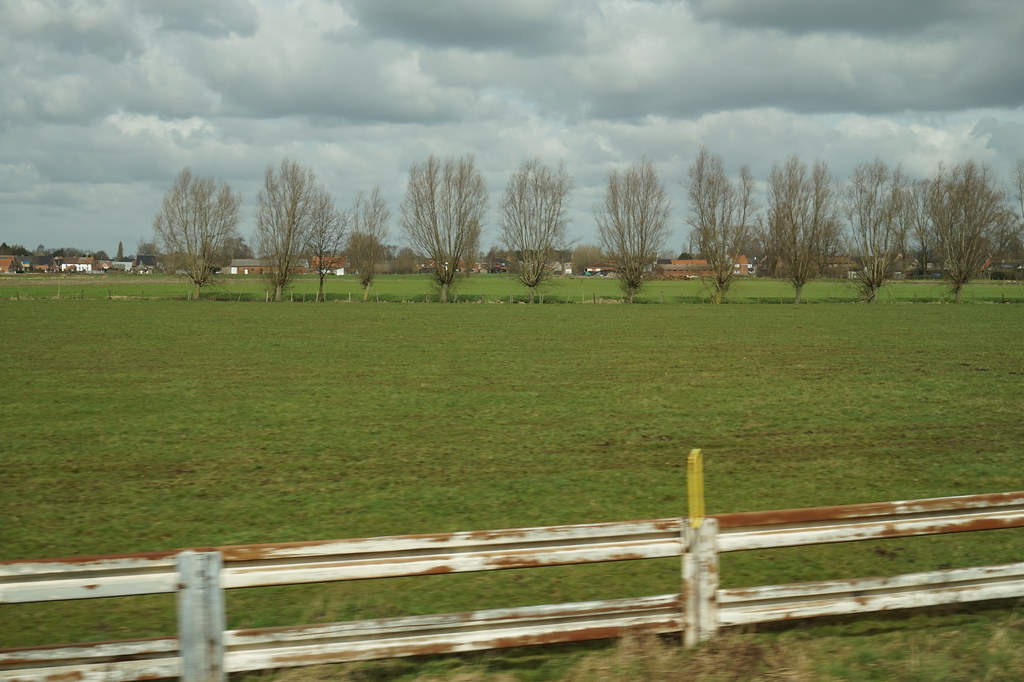
IMG_20150401_173202220"But to enjoy the Low Countries, we have to put on a very particular pair of spectacles and bend our nose well over our task, and, beyond our consciousness that our gains are real gains, remain decidedly at loss how to classify them. This is the charming thing in Holland — the way one feels one's observation lowered to a relish of the harmonies of the minor key; persuaded to respect small things and take note of small differences; so that really a week's sojourn here, if properly used, ought to make one at the worst a more reasonable, and at the best a more kindly, person. The beauty which is no beauty; the ugliness which is not ugliness; the poetry which is prose, and the prose which is poetry; the landscape which seems to be all sky until you have taken particular pains to discover it, and turns out to be half water when you have discovered it; the virtues, when they are graceful (like cleanliness), exaggerated to a vice, and when they are sordid (like the getting and keeping of money), refined to a dignity; the mild gray light which produced in Rembrandt the very genius of chiaroscuro ; the stretch of whole provinces on the principles of a billiard- table, which produced a school of consummate landscapists; the extraordinary, reversal of custom, in which man seems, with a few windmills and ditches, to do what he will, and Providence, holding the North Sea in the hollow of his hand, what he can... " p. 383


2015.03.30-DSC00498Henry James, Transatlantic Sketches (1875)

""BELGIUM, in most itineraries, is visited conjointly with Holland...." Henry James #QotD

2015.03.30-DSC00497
"BELGIUM, in most itineraries, is visited conjointly with Holland. This is all very well so long as Belgium is visited first; and my advice to travellers who relish a method in their emotions is in this region to reverse the plan which is generally most judicious, and proceed in all confidence from south to north. Passing from the Low Countries into Flanders, you come back into the common world again — into a picturesque phase of it, certainly, and a country rich in architectural and artistic treasures."
p. 391
Henry James,  Transatlantic Sketches (1875) 

Whoops, this trip I went the wrong way! But headed back north to Holland on the return trip ...

Thursday, April 02, 2015

Ghent I found to be an enormous, empty city, with an old Flemish gable-end peeping here and there from its rows of dull, white houses, and various tall and battered old church-towers - H James #QotD

2015.04.01-DSC00696
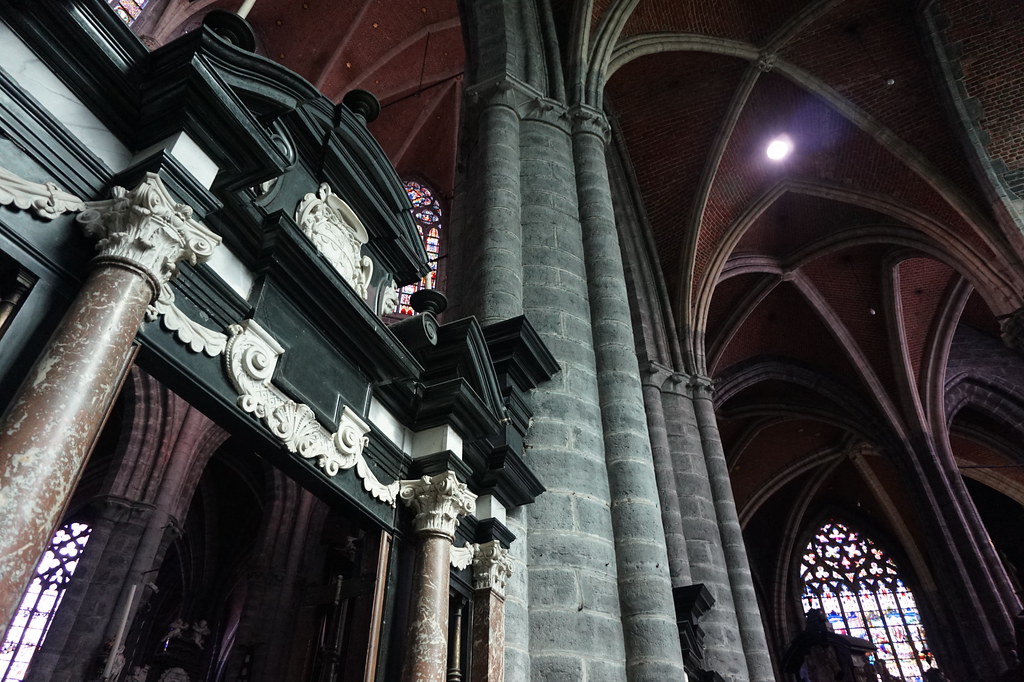
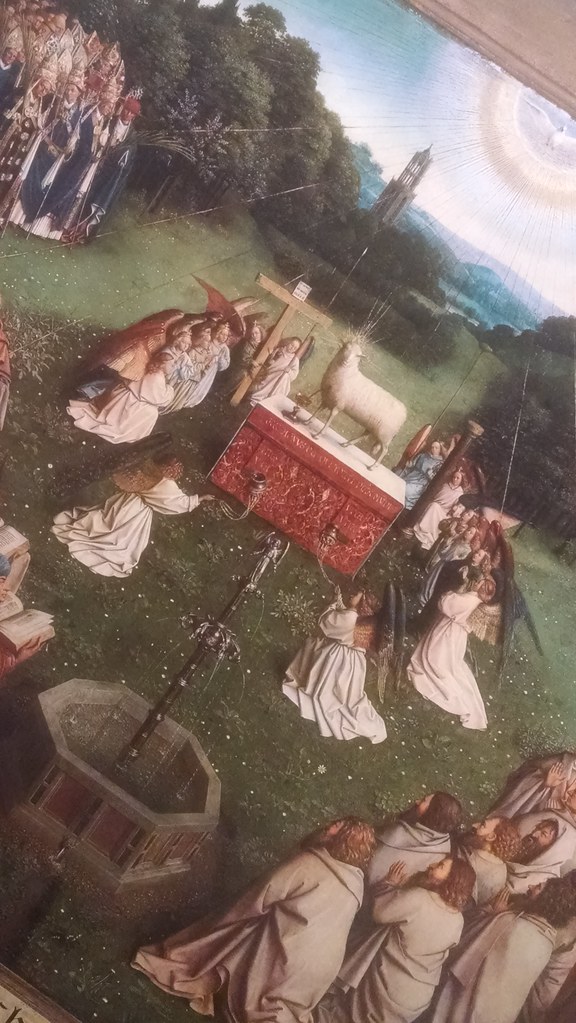
St. Bavo's Church, location of the "Adoration of the Lamb"
"Ghent I found to be an enormous, empty city, with an old Flemish gable-end peeping here and there from its rows of dull, white houses, and various tall and battered old church-towers looking down over deserted, sunny squares. In the middle of all this, in the stately church of St. Bavon, is the great local treasure, the "Adoration of the Lamb," by the brothers Van Eyck This is not only one of the pictures of Ghent, but one of the pictures of the world. It represents a large daisied meadow shut in with a great flowering tangle of hedges, out of which emerge various saints of either sex, carrying crowns and palms. In front are two other groups of apostles and prophets, all kneeling and worshipping. In the centre is an altar, surmounted with the fleecy symbol of the Word, and surrounded with a ring of adoring angels. Behind is a high horizon of blue mountains, and the silhouettes of three separate fantastic cities, all apparently composed of church-towers. The picture is too perfect for praise; the coloring seems not only not to have lost, but actually to have been intensified and purified, by time. One may say the same of the precious Memlings at Bruges — and this is all I can say of that drowsy little city of grassy streets and colossal belfries and sluggish
canals and mediaeval memories." p. 400-401

Henry James
Transatlantic Sketches (1875)


2015.04.01-DSC00707

Sunday, March 29, 2015

"It is impossible to imagine anything more expressive of the numerous ideas represented by the French epithet bourgeois than these straight facades of clean black brick capped with a rococo gable of stone painted white" H. James #QotD

2015.03.27-DSC00299
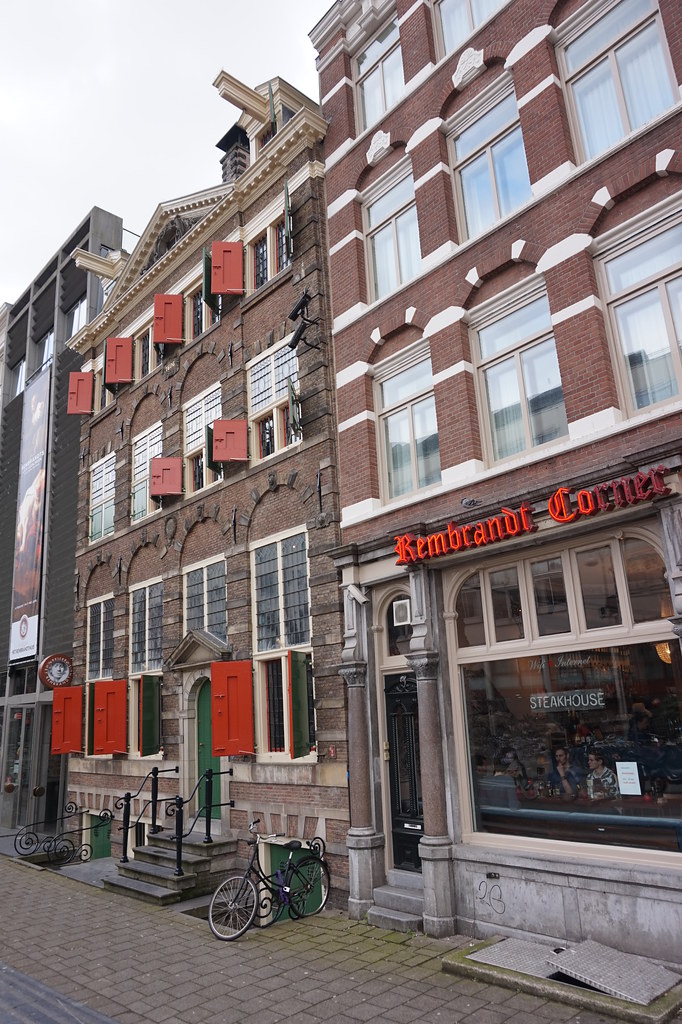
It is impossible to imagine anything more expressive of the numerous ideas represented by the French epithet bourgeois than these straight facades of clean black brick capped with a rococo gable of stone painted white, and armed like the forehead of the unicorn with a little horizontal horn — a bracket and pulley for hauling storable goods into the attic. The famous Dutch cleanliness seems to me quite on a level with its reputation, and asserts itself in the most ingenious and ludicrous ways ... The windows are of those huge plates of glass which offer a delectably uninterrupted field for friction; but they are masked internally by thick white blinds, invariably drawn, and the only use of their transparency to any mortal is to enable the passer-by to examine the texture of the stuff. The front doors are hedged in with little square padlocked barriers, to guard the doorsteps from the pollution of footprints, and the visitor must pocket his pride and apply at an humbler portal with the baker and the milkman. In such houses must dwell people whose nerves are proof against the irritation of minute precautions — people who cover their books with white paper and find occasion for a week's conversation in a mysterious drop of candle-grease on a tablecloth. 

Henry James. Transatlantic Sketches (1875) , p. 385-87

"The traveller with an eye for details will find some eloquence in the fact that, though the canals at Amsterdam and Leyden offer continually this charming pretext of trees by a water-side" H James #QotD

2015.03.27-DSC00242
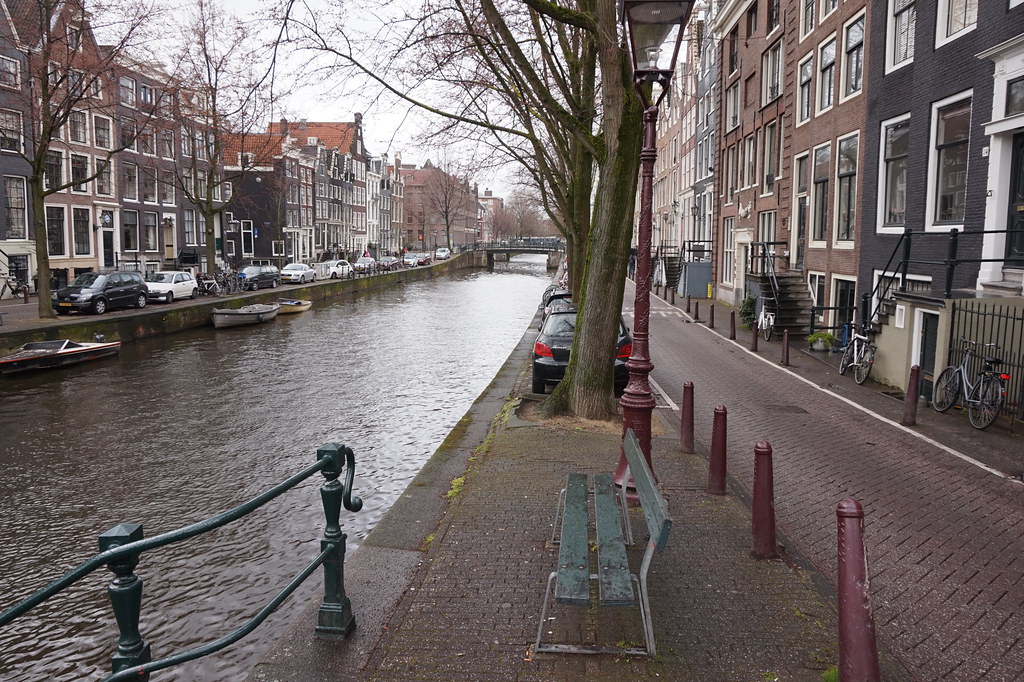
The traveller with an eye for details will find some eloquence in the fact that, though the canals at Amsterdam and Leyden offer continually this charming pretext of trees by a water-side, there is not in their whole length a single bench for a lounge and a half-hour's aesthetic relish of the situation. The traveller in question though, shrewd fellow, will not be prevented by the absence of benches from getting it, as he looks up and down and sees the wide green barges come floating through the respectable stillness, and the quaint old scroll-work of the gables peep out through the meagre density of the trees.
Henry James. Transatlantic Sketches (1875) , p. 387

Saturday, March 28, 2015

"Amsterdam, where I took my first Dutch walk, is a stately city, even though its street-vistas do look as if they were pictured on a tea-caddy or a hand-screen" H James #QotD

2015.03.27-DSC00251
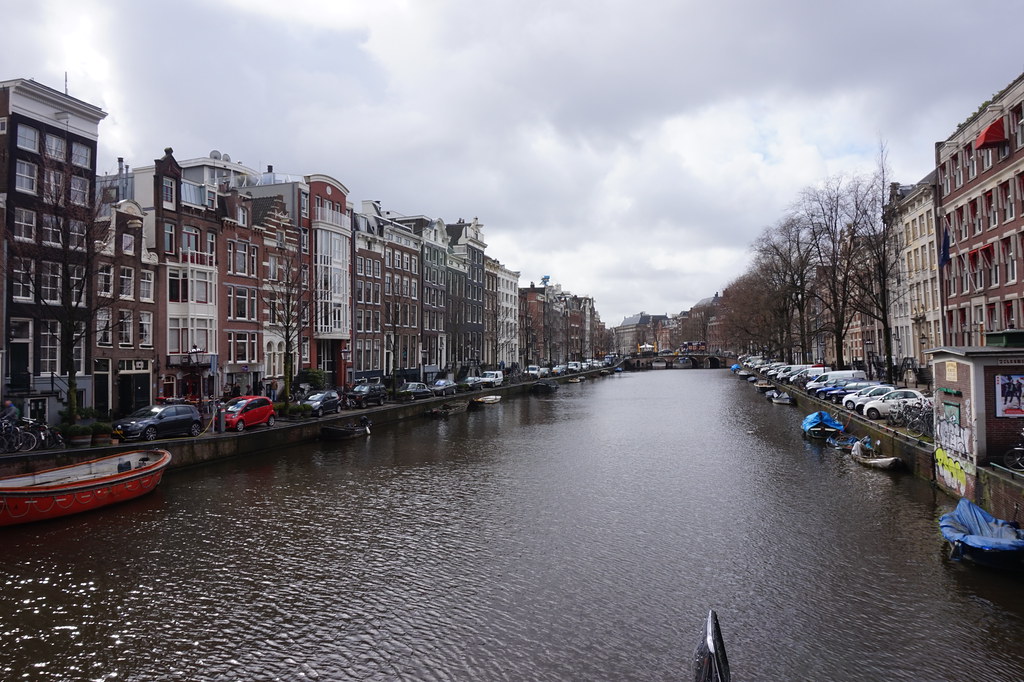
2015.03.27-DSC00250The curious fortunately excludes neither the impressive nor the agreeable; and Amsterdam, where I took my first Dutch walk, is a stately city, even though its street-vistas do look as if they were pictured on a tea-caddy or a hand-screen. They have for the most part a broad, sluggish canal in the middle, on either side of which a row of perfectly salubrious, but extremely attenuated trees grow out of a highly cultivated soil of compact yellow bricks. Cultivated I call it by a proper license, for it is periodically raked by the broom and the scrubbing-brush, and religiously manured with soap-suds. You lose no time, of course, in drawing the inevitable parallel between Amsterdam and Venice, and it is well worth drawing, as an illustration of the uses to which the same materials may be put by different minds. Sky and sea in both cases, with architecture between; winding sea-channels washing the feet of goodly houses erected with the profits of trade. And yet the Dutch city is a complete reversal of the Italian, and its founders might have carefully studied Venetian effect with the set purpose of producing exactly the opposite ones. It produces them in the moral line even more vividly than in the material.It is not that one place is all warm color and the other all cold; one all shimmer and softness and mellow interfusion of every possible phase of ruin, and the other rigidity, angularity, opacity, prosperity, in their very essence; it is more than anything that they tell of such different lives and of such a diflferent view of life. The outward expression on one side is perfect poetry, and on the other is perfect prose; and the marvel is the way in which thrifty Amsterdam imparts the prosaic turn to things which in Venice seem the perfect essence of poetry. Take, for instance, the silence and quiet of the canals; it has in the two places a difference of quality which it is almost impossible to express. In the one it is the stillness of order, and in the other of vacancy — the sleep of idleness and the sleep of rest; the quiet that comes of letting everything go by the board, and the quiet that comes of doing things betimes and being able to sit with folded hands and say they are well done. In one of George Eliot's novels there is a portrait of a thrifty farmer's wife who rose so early in the morning to do her work that by ten o'clock it was all over, and she was at her wit's end to know what to do with her day. This good woman seems to me an excellent image of the genius of Amsterdam as it is reflected in the house-fronts — I penetrated no deeper. 

Henry James. Transatlantic Sketches (1875) , p. 384-85.

Henry James visited Holland in 1874

Saturday, November 02, 2013

Henry James on the "extravagant" figure of Dante as depicted at Santa Croce

2013.10.31-IMG_7219
"The place is the great Florentine Valhalla, the final home or memorial harbour of the native illustrious dead, but that consideration of it would take me far. It must be confessed moreover that, between his coarsely-imagined statue out in front and his horrible monument in one of the aisles, the author of The Divine Comedy, for instance, is just hereabouts rather an extravagant figure". - Henry James, Italian Hours (1909)

I must confess that James is spot on in his assessment of the sculptural renditions of Dante that have become the model for how we picture him. I can't imagine that he's always that stern or unhappy looking as depicted at Santa Croce!


2013.10.27-IMG_6512
Detail of Dante's Tomb, Santa Croce

Henry James on the Duomo in Florence: "for all its solemn hugeness, strikes the same note of would-be reasoned elegance and cheer"

2013.10.28-IMG_6759The Cathedral, externally, for all its solemn hugeness, strikes the same note of would-be reasoned elegance and cheer; it has conventional grandeur, of course, but a grandeur so frank and ingenuous even in its parti-pris. It has seen so much, and outlived so much, and served so many sad purposes, and yet remains in aspect so full of the fine Tuscan geniality, the feeling for life, one may almost say the feeling for amusement, that inspired it.

 Henry James, Italian Hours (1909)

Tuesday, October 29, 2013

Along the Arno with Henry James / "... because the river is yellow, and the light is yellow ... "

2013.10.27-IMG_6598
As I crossed the Ponte Vecchio the other evening, as dusk was approaching, I thought of Henry James' description of the Arno at Florence from Italian Hours (1909):
"And yet forsooth, because the river is yellow, and the light is yellow, and here and there, elsewhere, some mellow mouldering surface, some hint of colour, some accident of atmosphere, takes up the foolish tale and repeats the note—because, in short, it is Florence, it is Italy, and the fond appraiser, the infatuated alien, may have had in his eyes, at birth and afterwards, the micaceous sparkle of brown- stone fronts no more interesting than so much sand-paper, these miserable dwellings, instead of suggesting mental invocations to an enterprising board of health, simply create their own standard of felicity and shamelessly live in it."