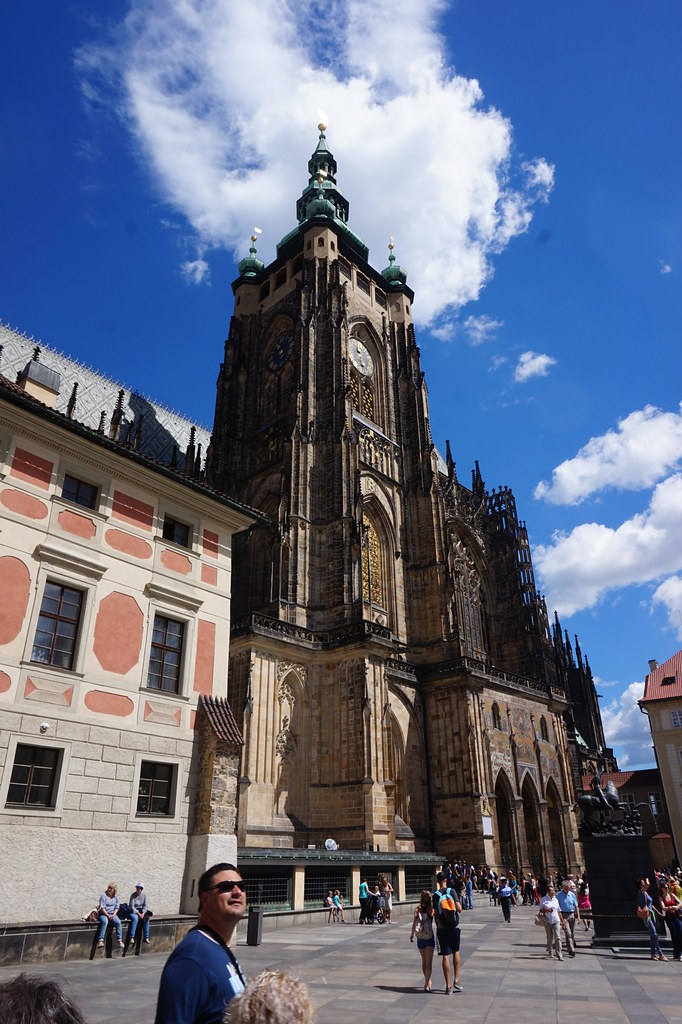
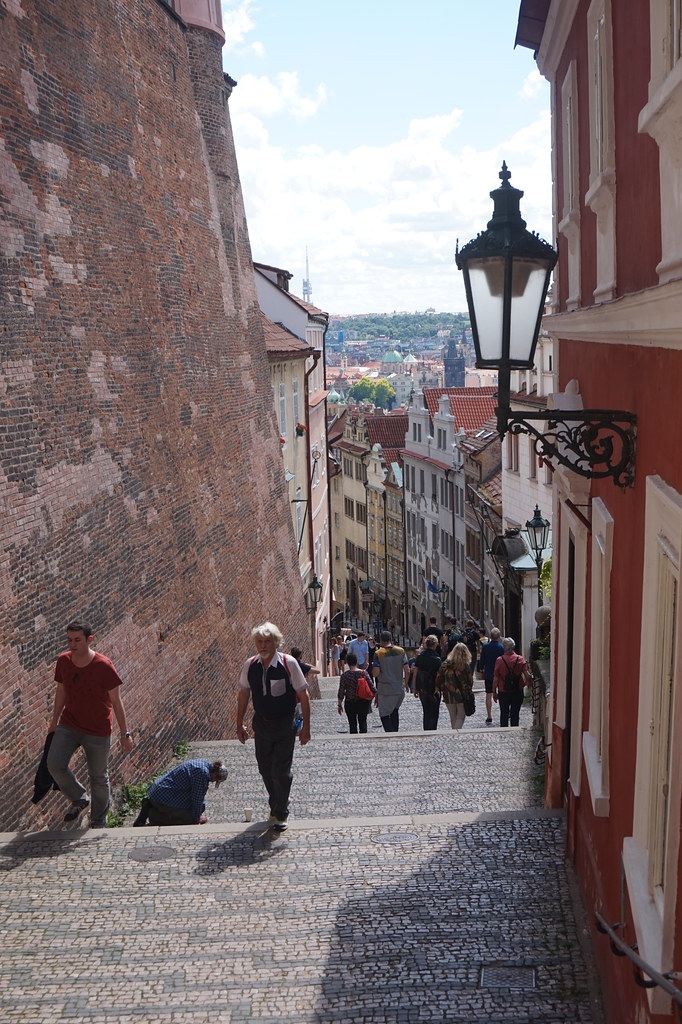
 I must say that I didn't have an enjoyable visit to the Prague Castle. The crowds were so intense there were spots where you couldn't even move. My experience, still, was better -- or different? than K's.
So, without further ado, here are some quotes from The Castle (German: Das Schloss) (1926) by Franz Kafka.
* * * * *
It was late evening when K. arrived. The village lay deep in snow. Nothing could be seen of the Castle Hill, it was hidden in mist and darkness, and not even the faintest gleam of light indicated the great castle there. For a long time K. stood on the wooden bridge leading from the main road to the village, looking up into the apparent emptiness.
He felt impelled to seek out new acquaintances, but each new encounter increased his weariness. If he forced himself in his present state to walk on as far as the entrance to the Castle, he would have done more than enough.
Above them the Castle, which K. had hoped to reach that day, already looked strangely dark as it receded from view. As if to bid him farewell for the time being, a bell rang out with a cheerful sound that, at least for a moment, set his pulse racing. It was also a poignant sound, as if it threatened to fulfil the obscure yearnings of his heart. But this great bell soon fell silent and was followed by a smaller one with a feeble, monotonous sound that might still have come from the Castle up there, or perhaps from the village below. Its chime was certainly better suited to his journey in the slow-moving sleigh and its pitiful but grimly determined driver.


The beer was poured out by a young girl called Frieda. She was an unremarkable fair-haired girl with a sad face and hollow cheeks, yet surprisingly she had a look of distinct superiority. As she glanced at K., he had the impression that this look had already settled certain things about him, things of which he was still quite unaware, but which were confirmed by her look.
You’re not from the Castle, you’re not from the village, you’re nobody. But unfortunately you are somebody, you’re a stranger who is one too many and gets in everyone’s way, who is forever causing trouble, who takes up the maids’ room, whose intentions are unknown. You have seduced our dear little Frieda, and now unfortunately we have to let you marry her. I’m not actually blaming you for all that; you are what you are, and I’ve seen too many things in my life not to be able to face this prospect as well. But just think what it is you’re asking for.
it makes my head spin when I listen to you expressing your opinions, and compare what you say with the actual situation. Your ignorance can’t be cured all at once, and perhaps it can’t be cured at all, but things can be made better if you only believe some of what I say, and if you always remember how little you know.
The importance of the case does not depend on the amount of work it creates; if you think that, you are a long way from understanding the authorities.
All these contacts are only apparent, but because of your ignorance of the circumstances you take them to be real.


‘You are right that statements from the Castle cannot be taken literally.
‘I want no favours from the Castle, only my rights.’
The Castle, its outlines already becoming blurred, lay as quiet as ever. So far K. had never seen the slightest sign of life up there; perhaps it was quite impossible to make out anything at that distance, and yet his eyes still sought it out and could not accept its stillness. When he looked at the Castle, it was sometimes as if he were watching someone who was sitting there gazing out calmly, not so much sunk in thought and therefore cut off from everything, but aloof and unconcerned, as if alone and unobserved, yet someone who must be aware that he was being observed without letting it disturb his calm in the slightest; and indeed – it was impossible to tell whether this was cause or effect – the gaze of the observer could find no hold and slipped away.
Perhaps your antics will leave deep footprints in the snow outside, but nothing more.’
‘It’s not encouragement he needs,’ said K., ‘encouraging him is the same as telling him he’s right, that he only has to carry on as he was doing before, but if he does that he will never achieve anything. You can encourage someone who is blindfolded to peer through the blindfold as much as you like, but he’ll never see anything; only when you remove it will he be able to see. Barnabas needs help, not encouragement.


Of course, we’re all told we belong to the Castle, that there is no gulf between us that needs to be bridged, and that may be true in the usual course of events; but unfortunately we’ve had occasion to see that just when it comes to something that matters, it’s not true.

I once heard of a young man who thought about the Castle day and night, he neglected everything else and people feared for his sanity because his whole mind was on the Castle up there; but in the end it turned out that it wasn’t actually the Castle he was thinking about, but the daughter of a woman from the Castle kitchens, and he got her, so he was all right again.’ ‘I think I’d like that young man,’ said K. ‘I doubt whether you’d like him,’ said Amalia, ‘but you might like his wife.
The officials are highly educated, but they are blinkered; in his own field it only needs a word for an official to grasp a whole train of thought, but you can explain something from another area for hours and he may nod politely, but he won’t understand a word.