Showing posts with label Boston. Show all posts

Sunday, January 31, 2016

Report on my activities at the 2016 ALA Midwinter meeting in Boston #ALAMW16

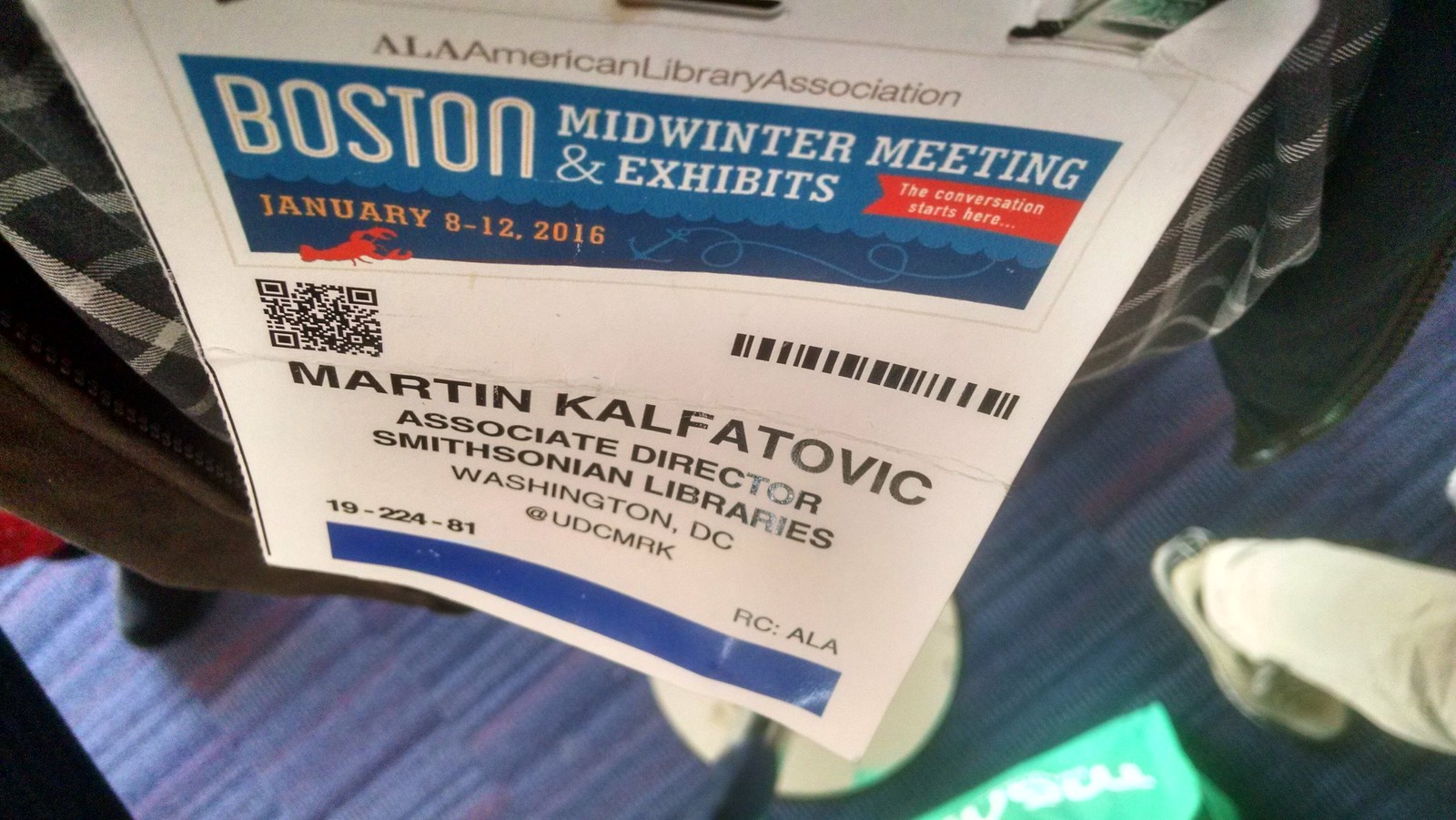
IMG_20160111_150830Travelling in unseasonably warm weather, I arrived in Boston on 7 January. The next morning, I spent at Harvard University meeting with various colleagues of the Biodiversity Heritage Library (see separate report on those meetings). That evening I met up with colleagues from LITA to catch up on their work and activities.

On Saturday, I attended the ARL Committee on Diversity Luncheon (on behalf of Nancy Gwinn). At the luncheon were various ARL directors or their representatives, ARL staff, and the many of the ARL Diversity Scholars (including the Smithsonian Libraries' Monique Libby who was selected for the 2015-17 cohort).

IMG_20160111_092918676That day was also my opportunity to visit the vendor exhibits and meet with representatives of a number of firms that Smithsonian Libraries has done business with (including the Internet Archive). That evening, ProQuest hosted a reception at the New England Aquarium where I met up with a number of other colleagues.

Sunday, Carolyn Sheffield and I met with Christine Giannoni (The Field Museum, Chicago) to discuss planning for the upcoming BHL Annual meeting. Monday was the OCLC Research Update which is always a highlight of any ALA. The program was:
  • OCLC Research Overview – Eric Childress
  • The Library in the Life of the User – Lynn Silipigni Connaway
  • Looking Inside the Library Knowledge Vault – Jeff Mixter
  • Working with OCLC Research Library Partners on Organizational Identifiers – Karen Smith-Yoshimura
IMG_20160111_102906408

I also attended closing speaker Chelsea Clinton's talk which promoted her new book, It’s Your World: Get Informed, Get Inspired & Get Going!. Tuesday morning, before catching my flight back, I stopped by the Old Granary Burying Ground to pay a visit to the grave of Mother Goose.

IMG_20160109_085145 IMG_20160110_134653527 2016.01.11-IMG_5486

IMG_20160112_113221098

Tuesday, January 20, 2015

A recap of Envisioning our Information Future and How to Educate for It #InfoFuture

I spent much of last week at an innovative conference/workshop, "Envisioning our Information Future and How to Educate for It" at the Graduate School of Library and Information Science at Simmons College (Boston, MA).

The workshop (funded via an IMLS grant led by Dr. Eileen G. Abels, Graduate School of Library and Information Science, Simmons College along with partners Dr. Linda C. Smith, Graduate School of Library and Information Science University of Illinois, Urbana-Champaign and Dr. Lynne C. Howarth, Faculty of Information, University of Toronto) brought together a diverse group of library (and archives and museums) practitioners, funders, educators, and users from across the US and Canada.

Many there were familiar faces (complete list of participants), but I also met a number of interesting new people.

Let by a pair of facilitators from the firm Tomorrow Makers, there were various group activities, innovative reporting out and kinesthetic exercises to inspire explorations on what "information services" and how to train future generations, is.

Personally, I felt there was too much dancing around the topic til the third day. Never a fan of "information services", lukewarm to "information science", and a big fan of just plain "libraries, librarianship, and librarians". The concept of "taking back the term library"was batted around a bit.

We were also asked to bring along an object and a book that would be part of the events. The range of items was quite interesting. It was fun to see that one of the books (not from me) was Smithsonian Secretary Clough's Best of Both Worlds (on digitization and collections). You can see what I brought and why at this post "McLuhan, Lincoln, and Dodos: Attending "Envisioning Our Information Future and How to Educate for It" at @SimmonsSLIS this week"


Some more shots of the meeting:


Wednesday, January 14, 2015

McLuhan, Lincoln, and Dodos: Attending "Envisioning Our Information Future and How to Educate for It" at @SimmonsSLIS this week

IMG_20150111_144749907
I had the pleasure and honor to be invited to attend the Envisioning Our Information Future and How to Educate for It meeting at Simmons College this week.

The meeting will:
Focusing on the importance of leadership and cutting-edge skills in LIS education, this conference represents an opportunity for “evaluating and implementing relevant curriculum focused on innovation, continuous learning, and critical engagement within a global context.” The grant for this conference was led by Dr. Eileen G. Abels, Graduate School of Library and Information Science, Simmons College along with partners Dr. Linda C. Smith, Graduate School of Library and Information Science University of Illinois, Urbana-Champaign and Dr. Lynne C. Howarth, Faculty of Information, University of Toronto.
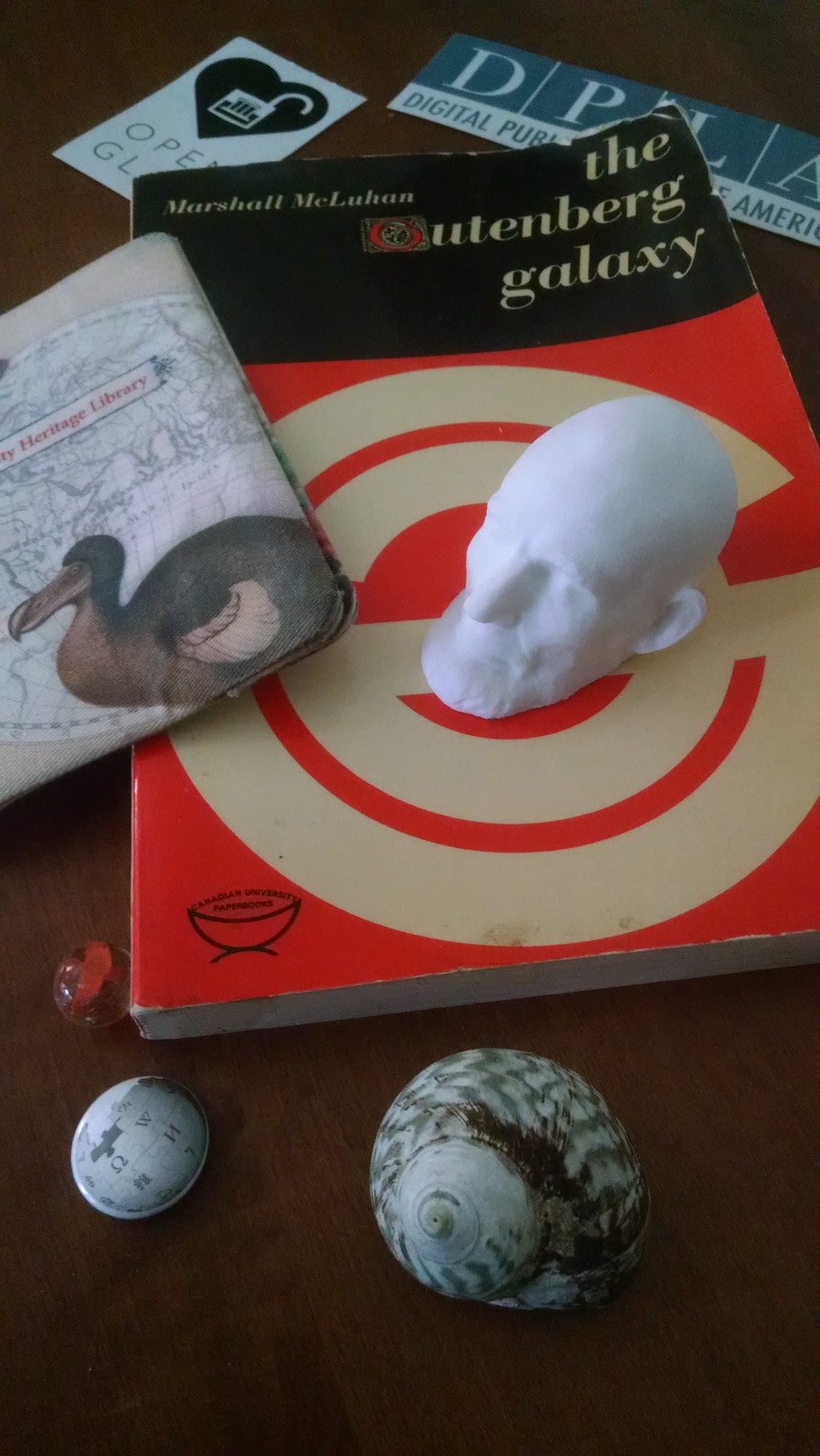
As part of the process, we were asked to bring a book and an object for a "pop up" gallery/exhibition. For my book, I chose The Gutenberg Galaxy: The Making of Typographic Man (1962) by Marshall McLuhan. In many ways a more evocative work than McLuhan's seminal Understanding Media (1964) -- at least for me. Like much of his work, it is hard to tell if McLuhan was a predictor of our digital present or a shaper/creator of it.

For my object, I chose a small, 3D print of the Abraham Lincoln life mask done by the sculpture Clark Mills from the collection of the Smithsonian's National Portrait Gallery. The 3D model can be downloaded and printed from the Smithsonian 3D site. I chose the model of the life mask not just because 3D printing is an overhyped part of any discussion of libraries (and museums), but because of the way that, beyond the hype around all things "3D", it really becomes transformative to hold in your hands (even in this small version -- I've held the life-sized replica also) this bit of the physical Lincoln and see the effects of four years of Civil War on the President's face.

More about the life mask:
It is impossible to look at this cast of Lincoln’s face—gaunt and careworn—and not think that it is a death mask. In fact, it was taken from life on February 11, 1865, a day before Lincoln’s fifty-sixth birthday, by sculptor Clark Mills. The 3-D object you see is a 1917 copy from the casting given to the Smithsonian in 1889 by the sculptor’s son.
Life masks were very popular in the nineteenth century because they created a near-duplicate of the sitter’s features. Throughout the Civil War, Lincoln was also very careful to make himself "visible" to the American people. This was evidence of his dedication, and there was no better evidence of his work than the lines on his face. Lincoln was well aware of how the war had aged and tired him.
2015.01.14 Envisioning / SimmonsAnd as for the dodo ... the dodo (Raphus cucullatus) is an extinct flightless bird, once a native of the island of Mauritius. First described in 1598, it was gone by 1681. Well adapted to its environment, the dodo had evolved to fill a needed niche. But times changed. And the dodo, lacking the ability to change with the times, became, instead of a symbol of perfect adaptation, the ultimate in the opposite.

In times of change, lack of adaptation leads to extinction. Let's adapt our educational model for librarianship to avoid the fate of the dodo.

As in Life, so in technology. As in libraries.