Showing posts with label Meetings of Various Kinds. Show all posts

Saturday, July 04, 2020

Digital Libraries for Open Knowledge: 23rd International Conference on Theory and Practice of Digital Libraries, TPDL 2019 Oslo, Norway / COVID-19 Professional Reading

Digital Libraries for Open Knowledge: 23rd International Conference on Theory and Practice of Digital Libraries, TPDL 2019 Oslo, Norway, September 9–12, 2019, Proceedings. Editors Antoine Doucet; @antoine_isaac; @koraljkagolub; @traalberg; Adam Jatowt. ISSN 1611-3349 (electronic).
https://doi.org/10.1007/978-3-030-30760-8.  421 pp. COVID-19 Professional Reading.

The "Theory and Practice in Digital Libraries" (TPDL) conference brings together researchers, developers, and data experts in the field of digital libraries. This year’s theme was “Connecting with Communities.” Digital libraries and repositories store, manage, represent, and disseminate rich and heterogeneous data that are often of enormous cultural, scientific, educational, artistic, and social value. Serving as digital ecosystems they provide unparalleled opportunities for novel knowledge extraction and discovery. This year’s conference, TPDL 2019, was held 9-12 September 2019 in Oslo, Norway.


I attended the 2019 TDLP and presented, on behalf of my co-authors, the poster session, “The Biodiversity Heritage Library: Unveiling a World of Knowledge About Life on Earth.” Martin R. Kalfatovic, Grace Costantino, and Constance A. Rinaldo. 


The meeting was very informative with many excellent presentations. Papers of note at the meeting included: 


  • Coner: A Collaborative Approach for Long-Tail Named Entity Recognition in Scientific Publications / Daniel Vliegenthart, Sepideh Mesbah, Christoph Lofi, Akiko Aizawa, and Alessandro Bozzon

  • The OpenAIRE Research Community Dashboard: On Blending Scientific Workflows and Scientific Publishing / Miriam Baglioni, Alessia Bardi, Argiro Kokogiannaki, Paolo Manghi, Katerina Iatropoulou, Pedro Principe, André Vieira, Lars Holm Nielsen, Harry Dimitropoulos, Ioannis Foufoulas, Natalia Manola, Claudio Atzori, Sandro La Bruzzo, Emma Lazzeri, Michele Artini, Michele De Bonis, and Andrea Dell’Amico

  • A Framework for Citing Nanopublications / Erika Fabris, Tobias Kuhn , and Gianmaria Silvello

  • Who is Mona L.? Identifying Mentions of Artworks in Historical Archives / Nitisha Jain and Ralf Krestel

  • Gatekeeper: Quantifying the Impacts of Service to the Scientific Community / Spyke Krepsha and Dongwon Lee

  • Can Language Inference Support Metadata Generation? / José María González Pinto, Janus Wawrzinek, Suma Kori, and Wolf-Tilo Balke

  • The CSO Classifier: Ontology-Driven Detection of Research Topics in Scholarly Articles / Angelo A. Salatin, Francesco Osborne, Thiviyan Thanapalasingam, and Enrico Motta

  • Non-Parametric Subject Prediction / Shenghui Wang, Rob Koopman, and Gwenn Englebienne


Overall, an excellent meeting (and proceedings) that covers current trends and research in digital libraries.


Monday, November 13, 2017

Bracing for Impact: Smithsonian Digitization Fair 2017

Bracing for Impact: Smithsonian Digitization Fair 2017

The Smithsonian Institution's Digitization Program Office organized the Institution's Digitization Fair on 18-19 October 2017 in the S. Dillon Ripley Center in Washington, DC. The theme of this year's fair was "Bracing For Impact". The fair explored how digitized collections can affect lives in significant and measurable ways by:

  • Showcasing examples where digitized collections have initiated creativity, innovation and change in some area of human endeavor;
  • Exploring ways museums, archives and libraries can maximize the impact of their digitized collections; and
  • Investigating ways museums, archives and libraries can measure the impact of their digitized collections

I participated on day two during the panel, Facilitating Impact: Open Access. My talk, “'The Gift of Time': Impact through Open: The Biodiversity Heritage Library" spoke to the importance of providing open access to scientific and cultural property when not impeded by legitimate legal or other concerns.


Dr. David Skorton, Secretary, Smithsonian Institution, provided a welcome to participants and attendees and was followed by an introduction by Diane Zorich, Director, Digitization Program Office. The first day opened with a keynote by Brian Mathews, Vice President, Platform Engineering, Autodesk, Inc. and was followed by a responder panel composed of:

  • Moderator: Victoria Portway, Head of Digital Experiences, National Air & Space Museum, Smithsonian Institution
  • Desi Gonzalez, Manager of Digital Engagement, The Andy Warhol Museum
  • John Hessler, Curator of the Jay I. Kislak Collection of the Archaeology & History of the Early Americas, Geography and Map Division, Library of Congress

The remainder of the first day was comprised of the following panels:

Panel One: Showcasing Impact in Art, Education and Research

  • Moderator: Effie Kapsalis, Chief of Content and Communications Strategy, Smithsonian Institution Archives
  • Corey Kilbane, Chemistry Teacher and Science Innovation Coach, William Penn Charter School
  • Alan Newman, Chief, Digital Media, National Gallery of Art
  • Michael Weinberg, General Counsel, Shapeways


Panel Two: Showcasing Impact with Emerging Platforms

  • Moderator: Elizabeth Neely, Senior Director Integrated Content, American Alliance of Museums
  • Paul Frandsen, Research Data Scientist, Biodiversity, Office of the Chief Information Officer, Smithsonian Institution
  • Meghan McCarthy, Project Lead, NIH 3D Print Exchange
  • Rolf Mueller, Associate Professor, Department of Mechanical Engineering, Virginia Tech


Panel Three: Manufacturing Impact

  • Moderator: Shannon Perich, Curator, Photographs, National Museum of American History, Smithsonian Institution
  • Josh Hadro, Deputy Director, New York Public Library Labs
  • Leah Weinryb Grohsgal, Senior Program Officer and National Digital Newspaper Program Coordinator, National Endowment for the Humanities
  • Gerald "Stinger" Guala, Branch Chief Eco-Science Synthesis, Director Integrated Taxonomic Information System, United States Geological Survey

Panel Four: Measuring Impact

  • Moderator: Stephanie Norby, Director, Smithsonian Center for Learning and Digital Access
  • Ricardo Punzalan, Assistant Professor, College of Information Studies, University of Maryland
  • Madlyn Runburg, Director of Education Initiatives, Natural History Museum of Utah
  • Harry Verwayen, Deputy Director, Europeana

The day closed with a Closing Keynote Address: Open Access Oceans: Framing Stories for Impact by Erika Woolsey, CEO & Co-Founder, The Hydrous

The second day started with a keynote by Dr. Ian Owens, Director of Science, Natural History Museum, London. Dr. Owens, in his talk, "The New Enlightenment," spoke on the importance of natural history collections and how digitization will assist and change the ways collections are used. He also pointed out the importance of the Biodiversity Heritage Library as a component of these collections. A responder panel built on Owens talk:

  • Moderator: Maureen Kearney,  Associate Director for Science, National Museum of Natural History, Smithsonian Institution
  • Catherine Eagleton, Associate Director for Curatorial Affairs, National Museum of American History, Smithsonian Institution
  • Scott Miller, Deputy Under Secretary for Collections & Interdisciplinary Support, Smithsonian Institution

This was followed by panels on the following topics:

Panel One: Showcasing Impact

  • Moderator: Mark Kornmann, Director, Office of Public Engagement, National Air & Space Museum, Smithsonian Institution
  • Laura Coyle, Head of Cataloging and Digitization, National Museum of African American History & Culture, Smithsonian Institution
  • Karen Lemmey, Curator of Sculpture, Smithsonian American Art Museum, Smithsonian Institution
  • Stephanie Norby, Director, Smithsonian Center for Learning and Digital Access
  • Matilda McQuaid, Museum Curator, Textiles, Cooper Hewitt Smithsonian Design Museum

Panel Two: Facilitating Impact: Open Access

  • Moderator: Anne Collins Goodyear, Co-Director, Bowdoin College Museum of Art
  • Rachel Allen, Deputy Director, Smithsonian American Art Museum, Smithsonian Institution
  • Lauryn Guttenplan, Associate General Counsel, Smithsonian Institution
  • Martin Kalfatovic, Associate Director, Smithsonian Libraries; Program Director Biodiversity Heritage Library, Smithsonian Institution

Panel Three: Resourcing for Digitization Impact

  • Moderator: Al Horvath, Under Secretary for Finance and Administration, Smithsonian Institution
  • Meghan Ferriter, National Digital Initiatives, Library of Congress
  • Robert Horton, Asst. Director, Collections & Archives, National Museum of American History, Smithsonian Institution
  • Jaap Otte, Senior Gift Officer, Smithsonian Institution
  • William Tompkins, Director, National Collections Program, Smithsonian Institution

Friday, November 10, 2017

Smithsonian | Leibniz Association Meetings, October 2017

Smithsonian Secretary David Skorton (r) and 
Leibniz Association President Matthias Kleiner (l)
Nancy E. Gwinn and Martin R. Kalfatovic attended a two day meeting, "Aim, Scope, and Challenges of Research Museums: An exchange between the Smithsonian Institution and the Leibniz Association " on 30-31 October. Anne Evenhaugen also participated in the meetings as part of her Emerging Leadership Development Program. Organized by Scott Miller, Deputy Undersecretary for Collections and Interdisciplinary Support (DUSCIS), the meeting brought together a number of Smithsonian staff and representatives from a number of the 91 institutional members of the Leibniz Association. The Leibniz Association is a union of German non-university research institutes from various branches of study and has a number of similarities to the Smithsonian Institution.

The meeting opened with a discussion between Smithsonian Secretary David Skorton and
Leibniz Association President Matthias Kleiner. The two discussed areas of overlap, common goals, and areas of collaboration between the two organizations. The first session was "Understanding of Research Museums at Smithsonian and Leibniz". Participants introduced themselves and Scott Miller provided an overview of the Smithsonian while Sunhild Kleingärtner (German Maritime Museum) did the same for the Leibniz Association.

There followed a number of focus sessions:

Focus: Evaluation Systems and Metrics
  • Smithsonian Speakers: Martin Kalfatovic (Bibliometrics, SRO), Amy Marino (Metrics and dashboards, Smithsonian Profiles)
  • Leibniz: Britta Horstmann (Leibniz Head Office)
Stephanie Norby, Smithsonian Education
Focus: Collections 
  • Smithsonian Speakers: Bill Tompkins (collections space), Diane Zorich (mass digitization), Martin Kalfatovic (Biodiversity Heritage Library)
  • Leibniz: Christoph Häuser (Leibniz-MfN) (German national digitization program); Helmut Trischler (Leibniz-DM)
Focus: Exhibitions
  • Smithsonian Speakers: Rex Ellis (National Museum of African American History and Culture)
  • Leibniz: Ruth Schilling (Leibniz-DSM); Daniel Hess (Leibniz-GNM)
There followed a discussion: Discussion / Questions: What status does research have in your exhibitions? How do research and exhibitions interact? What social role and responsibility do museums have with regard to a culture of remembrance (Erinnerungskultur)?

Focus: Research Themes for Potential Collaboration 
  • Smithsonian speakers: Stephanie Norby and Carol O’Donnell (education), Bob Koestler and Paula DePriest (materials conservation)
  • Leibniz: Alexandra Busch (Leibniz-RGZM, interdisciplinary research, e.g., Educational Research, Biodiversity, Cultural Heritage as a Resource), Stefan Brüggerhoff (Leibniz-DBM, collection-based research, e.g. Material Conservation Research, Historical Authenticity)

Summary and Concluding Remarks
The meetings concluded with a session on looking at further collaborations and next steps. Smithsonian Provost John Davis joined the group for this portion of the discussion. There was a discussion about possible collaborative projects around the German+American experience. The planned exhibition research from SAAM around Alexander von Humboldt.

Other topics for further conversations included education, material conservation, audience metrics, interactions of collections and research, staff exchange (specifically on the technical, digitization, and administrative), funding and business models, initiate a Smithsonian/Leibniz communication platform

* * * * *

Leibniz Association participating organizations:
  • Leibniz Association Head Office and Central Staff
  • Leibniz Association Senate 
  • Federal Ministry of Education and Research
  • Ministry of Culture and Science of the State of North Rhine-Westphalia
  • Deutsche Forschungsgemeinschaft (DFG) 
  • Deutsches Museum, Munich
  • Museum für Naturkunde Berlin
  • Senckenberg Gesellschaft für Naturforschung
  • Zoological Research Museum
  • German Maritime Museum
  • ermanisches National Museum
  • Museum für Naturkunde
  • Römisch-Germanisches Zentralmuseum 
Alexandra Busch, Director for Research
Römisch-Germanisches Zentralmuseum
* * * * *

The Smithsonian Research Online and Biodiversity Heritage Library presentations are available here:

Friday, April 21, 2017

The Open Scholarship Initiative 2017: Meeting report #OSI2017

The Open Scholarship Initiative 2017: Meeting report

I attended, along with Smithsonian Libraries' Director Nancy E. Gwinn, the 2017 Open Scholarship Initiative (OSI) meeting held at George Washington University, 19-21 April 2017. I also attended last year's meeting, held at George Mason University, which also attended by Nancy Gwinn and Mary Augusta Thomas.

The OSI is:
an ambitious, global effort to establish high level dialogue and cooperation on these issues. OSI is manged by the National Science Communication Institute (nSCI) in long-term partnership with UNESCO (the United Nations Educational, Scientific, and Cultural Organization). OSI brings together a diverse and high-level group of scholarly publishing decision makers from around the globe into a series of annual meetings that are thoughtfully designed and constructed so these leaders can personally share their ideas and perspectives and look for common ground and actionable solutions. Ideas generated at each meeting are refined throughout the year through a broadening circle of delegate voices, and can be formalized into decisions at annual meetings over the next 10 years, with the goal of ensuring that solutions are workable and widely adopted, and that new and remaining issues are continually reviewed and agreed-to solutions are fine-tuned.
Following on the work of last year's meeting, the main goal for OSI2017 is:
to lay the groundwork for making progress as a broad community on the workgroup issues and topics. OSI2017 groups (not just workgroups but also stakeholder and leadership groups) will also rough out specific solutions and frameworks, and the full group will debate broad issues affecting OSI and the full community.
The meeting opened with welcomes from Bhanu Neupane (Program Manager, UNESCO) and Geneva Henry (Dean of Libraries and Academic Innovation, George Washington University). This was followed by a talk by Internet pioneer (and current Google Vice President) Vint Cerf. Cerf gave a great and concise talk that keyed directly into the topic of Open Scholarship. Focusing on incentive and behavior, his take away quote was:
Whenever you see behavior you don't like, you need to understand the incentives behind the and change those incentives.
The rest of day one was focused on workgroup meetings. I participated in the workgroup, "Standards, Norms, and Best Practices" and the stakeholder group, "Scholarly libraries & groups". The charge of the work group was:

Standards, Norms, and Best Practices
What standards, norms, best practices, exit strategies, and incentive systems does the world of scholarly communications need? What is the future ideal? What will it take (including studies or pilots) to develop a better understanding of how the scholarly communication system works now? This workgroup will also necessarily touch on norms and definitions, so will include discussions as warranted about open and impact spectrums as covered in OSI2016.

This work group was an outgrowth of the "What is Open?" group that I participated in at OSI2016 (See Report from the "What Is Open?" Workgroup). Building on the D.A.R.T. framework (discoverable, accessible, reusable, transparent) as dimensions of "open", the group developed a matrix that outlined different stakeholders (funders, researchers, universities, libraries, societies, and publishers) and dimensions (Idea Generation, Knowledge Creation, Interpretation and Analysis, Dissemination, and Evaluation) and used this as a method of outlining where we are as well as facilitating a gap analysis.

The Scholarly libraries & groups stakeholder meeting focused on ways in which scholarly libraries (and related groups) have collaborated in the past and ways in which they can collaborate in the future.

Day two continued the work of the workgroups and stakeholder sessions and concluded with reports from the work groups. The final half day continued the work group and stakeholder reports. There was an opportunity for a series of "fast pitch" talks where participants could describe an ongoing or planned project to create awareness or seek support or participation.

The meeting concluded with final thoughts by Keith Yamamoto (Vice Chancellor for Science Policy and Strategy at UC San Francisco). Yamamoto gave a summary of his thoughts about where OSI has been, what was accomplished at this meeting and what the ambitions for the group going forward can be.

In conclusion, Yamamoto noted of OSI, there are:

  • Great challenges
  • Awesome conceptual ambitions
  • Undefined output aspirations


Tuesday, September 13, 2016

Report on the ICSTI 2016 General Assembly & Workshops

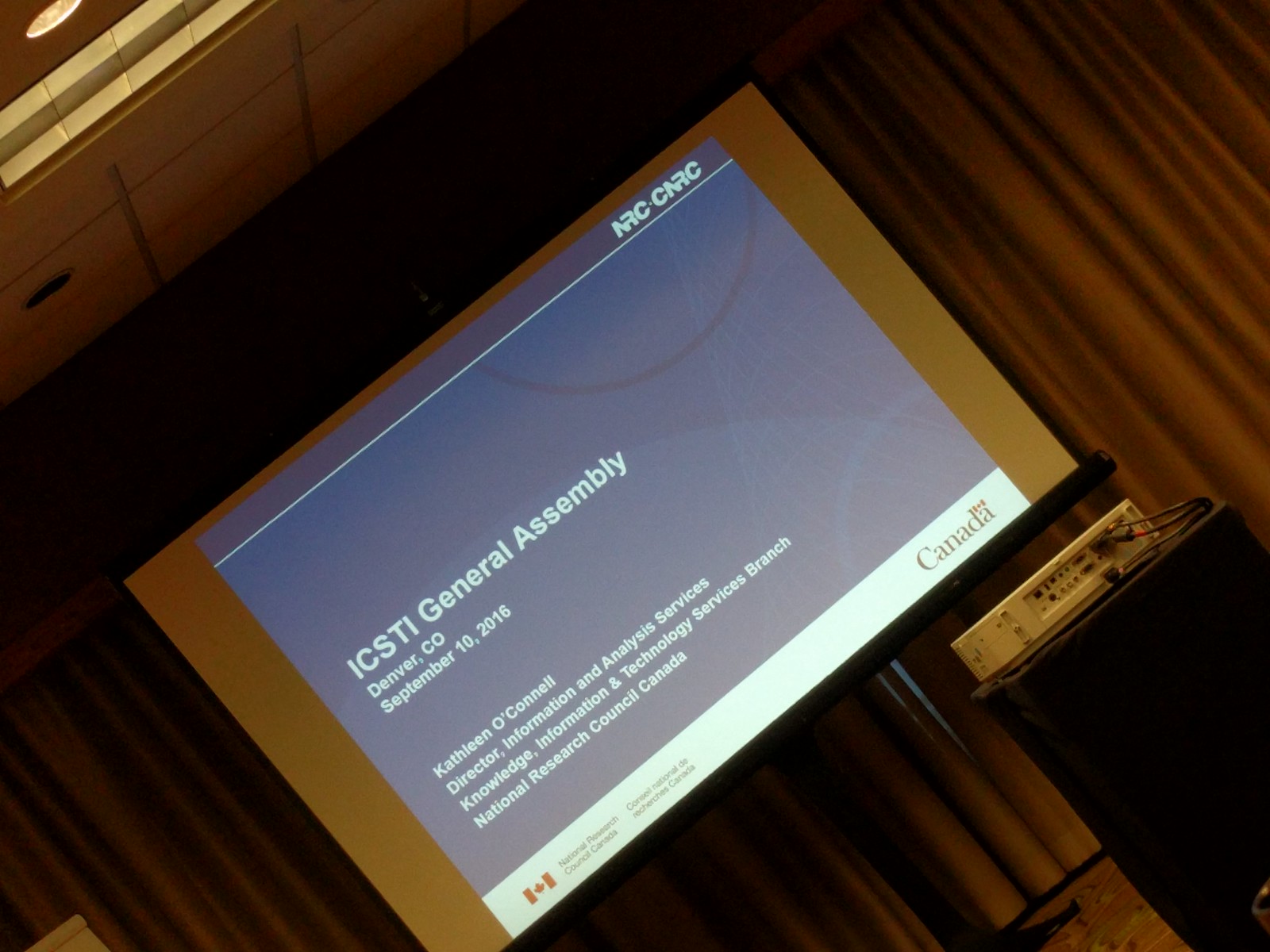
IMG_20160910_094921

The International Council for Scientific and Technical Information (ICSTI) 2016 General Assembly & Workshops

Denver | 10 September 2016 | Twitter Stream


On 10 September 2016 I attended the ICSTI 2016 General Assembly & Workshops in Denver with Suzanne Pilsk on behalf of Smithsonian Libraries.  ICSTI 2016 General Assembly was held in Denver to take advantage of the International Data Week meetings being held the following week.

The Member Initiative Presentations followed a brief business meeting.

Smithsonian Libraries were invited to present during the Member Initiatives session on the topic of Smithsonian Research Online and activities around that including the Public Access Mandate and the implementation of Smithsonian Profiles. Suzanne Pilsk wrote and delivered the presentation on behalf of SIL,

The other Member Initiative talks were by:
  • Kathleen O'Connell (National Research Council Canada)
  • Mustapha Mokrane (Inferential Council for Science on World Data Systems)
  • Tae-Sui Seo (Korea Institute of Science and Technology Information)
IMG_20160910_102427 IMG_20160910_101130 IMG_20160910_104347
(from left: Pilsk, Mokrane, Seo)

These talks were followed by two workshops:
  • Information Trends and Opportunities Committee (ITOC) Workshop 
  • Technical Activities Coordinating Committee (TACC) Workshop 


Information Trends and Opportunities Committee (ITOC) Workshop 
Enabling Innovations for Researcher Workflows and Scholarly Communication
"The Information Trends and Opportunities Committee (ITOC) is the catalyst for strategic thinking of ICSTI. It conducts foresight/horizon scanning to identify trends and opportunities of interest and relevance to ICSTI members. The Chair of ITOC is Margret Plank, Head of Competence Center for non-textual Materials at the German National Library of Science and Technology (TIB)."

Jeroen Bosman and Bianca Kramer (Utrecht University Library/101 Innovations in Scholarly Communication). Innovations in scholarly communication: openness, efficiency and reproducibility drivers.
  • For those of you who may not yet have looked at the 101 Innovations in Scholarly Communication project, it is worth your time. The project provides a valuable empirical underpinning from a survey of over 20,000 researchers on just how the core nature of scientific communication is changing.
Cameron Neylon (Force 11). From Principles to Action - The FORCE11 approach to innovation in scholarly communications. 
  • "FORCE11 started as a movement for change amongst a particular group of technically minded people in scholarly communication including publishers, technologists, researchers, advocates and funders. Over time it has evolved in a number of directions, now positioning itself as a forum where different stakeholder communities can come together to seek a consensus on how to move forward. In particular a pattern has emerged in which successful groups seek first to articulate and refine a set of principles that can help to guide implementation but do not specify it. If a wide consensus can be developed on principles then the next phase moves towards community implementation. The success and challenges of this approach will be discussed with examples."
Lambert Heller (German National Library of Science and Technology (TIB)). Wikidata and Wikimedia Commons as a platform for collaborative annotation and reuse for scientific data. 
  • Excellent talk about the use/re-use of Open Access literature within WikiSource.
Courtney Soderberg (COS, Center for Open Science). An Open Science Framework for managing and sharing research workflows. 
  • Soderberg's talk was an excellent and engaging discussion of the mission of the Center for Open Science (COS). COS's remit is to increase openness, reproducibility, and integrity of scholarly research.
Alex Viggio (University of Colorado Boulder). Lessons Learned from the OpenVIVO Experiment.
  • Very interesting overview of the OpenVIVO experiment. OpenVIVO is hosted version of the VIVO software (which runs Smithsonian Profiles) to which any researcher around the world can enter their own profile.

IMG_20160910_124210 IMG_20160910_122342 IMG_20160910_120904
(from left: Viggio, Soderberg, Heller)


Technical Activities Coordinating Committee (TACC) Workshop 
Trends in Scientific Software Development, Sharing, and Use
ICSTI’s Technical Activities Coordinating Committee (TACC) typically focuses on exploring and communicating technical aspects of innovative trends in information science-based tools that help make STI more useable and accessible. The Chair of TACC is Brian Hitson, Director US DOE/Office of Scientific and Technical Information (DOE/OSTI).

Jay Billings (Oak Ridge National Laboratory & DOE Office of Scientific and Technical Information). The New Department of Energy Software Center
  • Billings discussed the DOE's Software Center, why such a center is needed, and ongoing development efforts.
Andrea Ross (Eclipse Foundation). Eclipse Foundation: A symphony of R&D collaboration
  • Ross gave a fascinating talk about the Eclipse Foundation and its efforts to nurture a community of software developers collaborating on a massive scale to develop high quality software.
James Willenbring (Sandia National Laboratories). The IDEAS Scientific Software Productivity Project
  • The Interoperable Design of Extreme-scale Application Software (IDEAS Project is a collaborative project of the seven national labs, a university, and three major computing facilities. "A key deliverable of the IDEAS Project is the Extreme-scale Scientific Software Development Kit (xSDK), which strives to provide the foundation for an extensible scientific software ecosystem, with components developed by diverse, independent teams throughout the high-performance computing community."
Fernando Pérez (Lawrence Berkeley National Laboratory). Project Jupyter: from interactive data science to reproducible computing in HPC environments
  • "Project Jupyter is a language-agnostic platform for scientific computing and data science that is widely used in research, education and industry. It evolved from the original IPython project, an interactive shell for the Python programming language, as the ideas in IPython were generalized to represent interactive computational processes in any language."
Eleonora Presani (Elsevier). SoftwareX – A new Open Access software journal
  • Presani's talk, on the multidisciplinary SoftwareX journal was a fascinating discussion of ways to document and create a scholarly communication dialog around a deliverable product (sofware). Post talk discussion include some compare/contrast to Journal of Open Source Software. 
IMG_20160910_141001 IMG_20160910_142858 IMG_20160910_150132
(from left: Billings, Ross, Willenbring)

Friday, August 19, 2016

A report from the 82nd IFLA World Library and Information Congress

I had the opportunity to attend my first IFLA World Library and Information Congress (WLIC) this year in Columbus, Ohio. For those who don't know or can't Google, IFLA is the International Federation of Library Associations and "is the leading international body representing the interests of library and information services and their users. It is the global voice of the library and information profession." The IFLA WLIC brings together thousands of librarians from around the globe around common issues. And, like any good library meeting, has vendor exhibits and receptions.

Highlighted here are some of the sessions I attended:

Session 056 Caucus - USA
A meeting for all USA attendees

IMG_20160813_173522 IMG_20160813_175038 2016.08.13-DSC08486
(pictures from the USA Caucus)

The USA Caucus had nearly 1,200 attendees. The US had the single largest delegation (as the host country).

Session 069 Newcomers Session
Find out how to get the most from your IFLA WLIC 2016 experience, be it through professional interaction, updating your knowledge, socialising or social media. This session offers a brief introduction to aspects of the Congress and IFLA as an organisation. The Newcomers’ Session is a great opportunity to start building and expanding your professional network.

2016.08.14-DSC08487 IMG_20160814_090549 IMG_20160814_095333
(from left: Donna Scheeder, IFLA President; Gerald Leitner, IFLA Secretary General, and Natalia Molebatsi, IFLA WLIC 2016 Social Media Coordinator)

The Newcomers Session provided a great opportunity to learn about the complexities of IFLA and how to get the most out of the Congress and IFLA. IFLA President Scheeder and Secretary General Leitner welcomed us and encouraged full participation, reminding us that everyone is a newcomer at some point. A highlight for me was Natalia Molebatsi (South Africa) who gave a great presentation on how to use social media to enhance your Congress experience.

Session 070 Opening Session (SI)
Congress delegates will come together on Sunday, 14 August 2016 for the official opening of the 2016 WLIC. During the opening ceremony, delegates will be introduced to the history and culture of Columbus and the United States through music, dance and pageantry. The theme of the opening ceremony, "Invention and Innovation" will highlight science, industry and information.

IMG_20160814_113734 Ohio affirms Wright Brothers as first flyers at #wlic2016, take that #rio2016 2016.08.14-DSC08497
(from left, some visitors from the Columbus Zoo; celebrating the Wright Brothers; Native American drummers) 

The opening session is an opportunity for IFLA leaders to make speeches (check):

  • Address to Congress delegates, Donna Scheeder (IFLA President) 
  • Welcome Video       
  • Welcome to Columbus, Carol Pitts Diedrichs and Patrick Losinski (Co-Chair, U.S. National Committee, United States)

and for the host country to celebrate what makes them special. This 82nd Congress had a razzle-dazzle opening that celebrated the USA and Ohio:

  • Segment One: Ohio Famous Firsts       
  • Segment Two: America’s Famous Firsts and Through the Eyes of the Inventor       
  • Segment Three: Road Trip across America and its Iconic Libraries       
  • Welcome to the United States       
  • Grand Finale

The show was hosted by sports announcer Olivier Sedra revealed some unknown to me facts:

  • Ohio is home to Victoria's Secret, Abercrombie and Fitch, and Bath and Bodyworks (who knew);
  • Ohio is the number 3 fashion design city in the US (after New York and Los Angeles) -- the opening was done like a fashion show;
  • Lifesavers (the candy) were invented in Ohio (we were all given rolls of Lifesavers)
Session 088 Exhibition Opening Party

The first main day of the Congress also had an opening part of the Exhibit Hall where many of our familiar vendors were on display.

IMG_20160814_170700 VID_20160814_162030 VID_20160814_171717
(from left, mystery "game meat spread"; book cleaning machine; scary book scanner)

Many of the exhibitors were familiar from ALA; had a chance to chat with some that we've done business with in the past and some I may work with in the future.

Session 092 IFLA President’s Session - Answering the Call to Action: How Might We Respond to the Challenges Presented in the IFLA Trend Report
The world continues to experience a rapid pace of change since the launch of the IFLA Trend Report in 2013. The IFLA President’s Session will focus on how libraries have been responding to the continual changes in the information environment. The IFLA Trend report identified 5 high-level trends which have been discussed across the international library community over the past three years. Many in our community have answered the call to action.  The session will see the publication of a new update report summarising these discussions and the community’s response to the Trend Report.

IMG_20160815_094532 IMG_20160815_113516 IMG_20160815_105302
(from left, Mark Surman, Maura Marx, Fred Von Lohmann)

The speakers at the panel were:

  • Mark Surman, Executive Director, Mozilla Foundation, United States
  • Fred Von Lohmann, Copyright Legal Director, Google, United States
  • Jack Cushman, Library Innovation Lab Fellow, Berkman Klein Center for Internet and Society, Harvard University, United States
  • Maura Marx, Deputy Director, Library Services, Institute of Museum and Library Services (IMLS), United States
The closing presentation by Maura Marx was a tour-de-force call to action for librarians to "stop the same old librarian blah-blah-blah" and step up to take ownership of key issues around equity, privacy, and social justice. (Biodiversity Heritage Library factoid: Fred Von Lohmann was the BHL's first IP advisor when the Electronic Frontier Foundation did pro bono work for BHL and EOL).


Session 104 The Internet’s New Gatekeepers? Net Neutrality and Libraries - Copyright and Other Legal Matters (CLM) with Committee on Freedom of Access to Information and Freedom of Expression (FAIFE)
Net Neutrality is the term used to describe the principle by which all traffic – films, music, documents – is treated equally over an internet connection. It is threatened by actors who seek to give preference to one type of traffic over another, effectively restricting choice and determining which parts of the internet people will find easiest to use. Inevitably, the most powerful will be better placed to optimise the performance of their content.

For libraries, whose mission is to give access to knowledge equitably, the idea that access should be controlled or made harder for reasons which have nothing to do with fundamental rights is a worrying one. This session will explain more about what net neutrality is, and what it means for librarians and library workers, as summed up in IFLA’s Statement on the topic.
  1. Introduction
    Eve Woodberry, Chair of CLM, Australia
  2. Net Neutrality and Zero Rating: the societal context
    Corynne McSherry, Electronic Frontier Foundation, United States
  3. Net Neutrality and Zero Rating: legal aspects
    Stephen Wyber, Policy and Research Officer, IFLA, Netherlands
  4. Equal Before the Internet: IFLA Statement Offers Firm Support for Net Neutrality
    Amélie Vallotton, Globethics.net (FAIFE), Switzerland
  5. Implications of the IFLA Statement on Net Neutrality and Zero-Rating for Education and Practice
    Tomas A. Lipinski, CLM Member, School of Information Studies, University of Wisconsin-Milwaukee, United States
A panel that was the geeky flipside of the President's Session. The highlight was the fabulous presentation by Corynne McSherry (EFF) on the intricacies of net neutrality.

Session 112 Library engagement and Wikipedia
In this session we will explore the ongoing fruitful cooperation between libraries and Wikipedia. We will highlight some best practices and case studies around different library types engaging with Wikipedia. We hope to encourage a wider uptake of Wikipedia across the library world by showing the added value gained from previous cooperation between libraries and Wikipedia. We invite you all to join us for a stimulating and inspiring session.

  1. Opening and introduction to the subject
    Alex Stinson, Wikimedia Foundation/Wikipedia Library, United States; Jake Orlowitz, Wikimedia Foundation/Wikipedia Library, United States
  2. Wikipedia and public libraries
    Alex Stinson, Wikimedia Foundation/Wikipedia Library, United States
  3. Discussion Paper (Public Draft)
  4. Wikipedia and research libraries
    Vicki McDonald, State Library of New South Wales, Australia
  5. Open discussion moderated by the Wikipedia Library team

OCLC IFLA Reception

IMG_20160815_202141 IMG_20160815_202222 IMG_20160815_202443
(some pictures from OCLC HQ)

OCLC hosted a great reception at the recently re-modeled HQ in nearby Dublin, Ohio. A great opportunity to mix and mingle with colleagues from around the world and talk with colleagues from OCLC on their home turf. (I should point out a rightfully controversial method of serving of champagne).

Session 126 IFLA Highlights Session
Catch up with the past and get involved in the future! 
Join us for this snapshot of IFLA. Catch up with some of the most important work and successes for IFLA in the last year. Then learn more about the year ahead and key initiatives to benefit libraries and associations.

A great session (especially for a newcomer) that outlined some key recent achievements of IFLA and some previews of plans for the coming year.

Session 157 Cultural Evening
Location: COSI - The Center of Science and Industry

IMG_20160816_200419 IMG_20160816_201912 VID_20160816_200742
(scenes from the IFLA cultural evening)

The IFLA Cultural Evening was held at the Columbus Center of Science and Industry (a science museum). The COSI was divided into regions of the USA: West, East, Midwest, Mountain, and South. Each area had foods and entertainment from the region (I think the Midwest bratwurst were the best; the sushi disappeared really quickly). Music and librarian dancing ensued! Lots of dancing at the "silent disco" (look here if you're unclear what that is) and the Mountain area where some line dancing was attempted.

Session 163 Plenary Session
David S. Ferriero, Archivist of the United States, will be speaking at the Plenary Session on Wednesday, 17 August.

IMG_20160817_082528 IMG_20160817_090418 IMG_20160817_090400

David Ferriero, Archivist of the United States, gave a great talk that outlined some of the issues facing the U.S. National Archives and Records Administration and plans for the coming year.

I had to head out after this plenary session. There were still two full days of IFLA WLIC 2016 left (plus a Friday full of tours of local and nearby libraries).

But, I had to say "Goodbye, Columbus" ... and I'll leave you with a few other shots of the city.

2016.08.13-DSC08437 2016.08.14-DSC08509 2016.08.14-DSC08524
(from left): Ohio Statehouse; Scioto River; Looking over the Scioto River