Showing posts with label Apollo. Show all posts

Monday, July 20, 2015

"Giant steps are what you take / Walking on the moon" - Sting #QotD

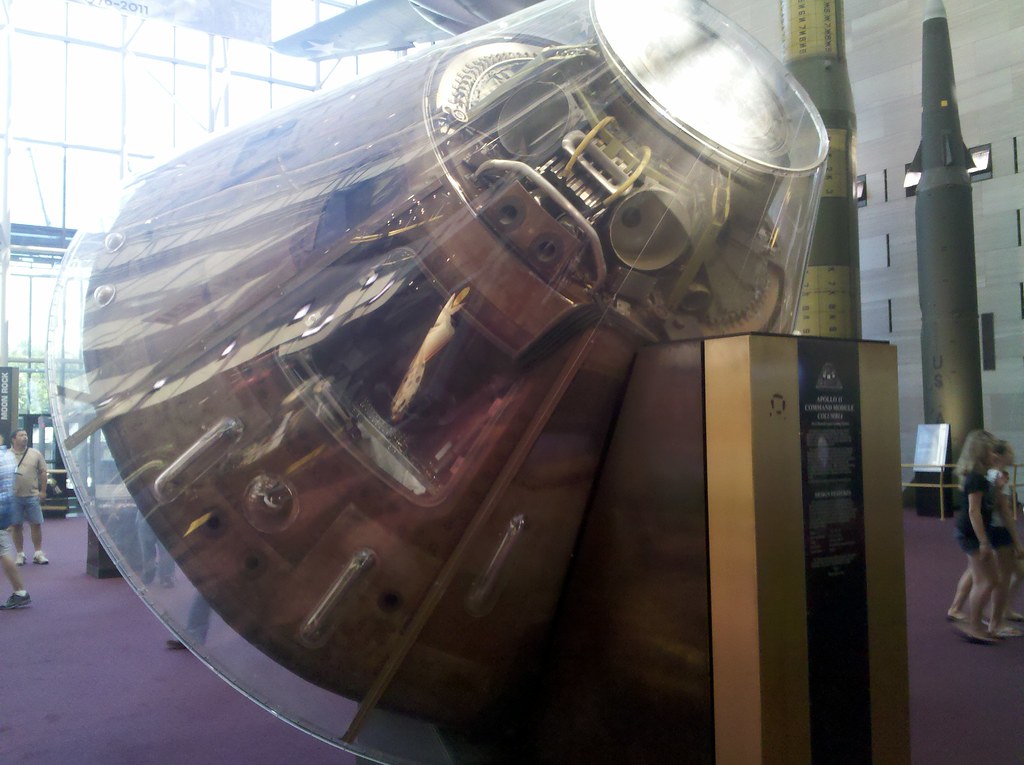
Apollo at NASM: Apollo 11 Command module
Apollo 11 Command Module, Smithsonian
National Air and Space Museum
Some may say
I'm wishing my days away
No way
And if it's the price I pay
Some say
Tomorrow's another day
You stay
I may as well play

Giant steps are what you take
Walking on the moon
I hope my legs don't break
Walking on the moon
We could walk forever
Walking on the moon
We could be together
Walking on, walking on the moon

"Walking on the Moon" The Police

Another year goes by and another year without people back on the moon, like they were in 1969, on this date, July 20 in fact. 46 years ago to be precise.

Some past Apollo posts:


Apollo at NASM: Model of Tranquility Base
Smithsonian  / Air and Space Museum / Tranquility Base

Saturday, July 20, 2013

QotD: "Where’s my donut-shaped space station? Where’s my ticket to Mars?" -- Neal Stephenson

2010-01-07-IMG_5790
"I have followed the dwindling of the space program with sadness, even bitterness. Where’s my donut-shaped space station? Where’s my ticket to Mars?" Some Remarks: Essays and Other Writing by Neal Stephenson
Well, here on the 45th anniversary of the moon landing, it looks like my donut-shaped space station is still just a painting on the walls of the Smithsonian, and my ticket to Mars is not in a whacky space suit, but via the Internet and some robotic controlled landers.


2012.06.29-IMG_4839

Friday, July 20, 2012

From Lunar Base Clavius to Tranquility Base

2012.06.29-IMG_4841July 20, 2012 marks the 43rd anniversary of the Apollo 11 moon landing. For many of us, however, the culmination of the US Space Program occurred back in April 1968, it was then that Stanley Kubrick released the amazing film, 2001: A Space Odyssey.

The movie was filled with icons of the space age: the Orion III Space Plane (which in 1968 was operated by Pan Am, but which today would probably be Virgin Galactic), TMA-1 (the Black Obelisk), the Discovery, and of course, HAL. 


I recently had the chance to see some of the original artwork (by Robert T. McCall)  from 2001: A Space Odyssey at the Smithsonian's Air and Space Museum (in a behind the scenes conference room). The iconic images of the Orion III and the space station were amazing to see again after all these years. Most interesting was the painting of  Lunar Base Clavius, where the astronauts are holding what could be an iPad!

2012.06.29-IMG_4843

For those interested in the iconography of the space age, I can't let this opportunity to give a nod to one of the best books on the topic, Another Science Fiction: Advertising the Space Race, 1957-1962 by Megan Prelinger (2010).

For more look backs at the Apollo program, see here (and some related posts on the HAL 9000 computer).

Saturday, December 17, 2011

Apollo 17: If you believed they put a man on the moon (well, they did in 1972)

Smithsonian Apollo Model

"If you believed they put a man on the moon, man on the moon
If you believe there's nothing up his sleeve, then nothing is cool"

- R.E.M., "Man on the Moon", Automatic for the People (1992)
In 1972 on this date, the last human - for the foreseeable future - walked on the moon. Gene Cernan, part of  the Apollo 17 team, was that last human (joined on the team by Harrison Schmitt and Ron Evans). The picture on the left isn't from that mission, but from a model around the Smithsonian. The real spacesuit is below.
Apollo 17
Apollo 17 patch from Matt707


From the Smithsonian e-Torch website:
Apollo 17 was the last Apollo mission to land men on the moon. It was launched by a Saturn V rocket Dec. 7, 1972, carrying Commander Eugene Cernan, command module pilot Ron Evans and lunar module pilot Harrison Schmitt, the only geologist to walk on the moon.
While Evans remained in lunar orbit in the command/service module, Cernan and Schmitt landed lunar module “Challenger” in the Taurus-Littrow region of the moon. They spent three days conducting three periods of extra-vehicular activity, or moonwalks, where they collected lunar samples and deployed scientific instruments.
While collecting a record 110 kilograms of lunar samples, they spent 22 hours outside of the lunar module and drove the lunar roving vehicle 35 kilometers. The crew landed in the Pacific Ocean Dec. 19, 1972.
Cernan still holds the distinction of being the last man to walk on the Moon; no humans have visited the moon since Dec. 14, 1972. This is Cernan’s spacesuit—the last spacesuit worn on the moon. When combined with the portable life-support system and other components making up the extra-vehicular mobility unit, it weighed about 185 pounds on Earth. It was transferred to the Smithsonian’s National Air and Space Museum from NASA in 1974.
Thanks to Matt707 for the Apollo 17 patch (upper right)

Wednesday, July 20, 2011

Shooting for the moon ... 42 years later ...

I was a child of the space age, born just eight days after Yuri Gagarin became the first human in space. Growing up all through the Sixties, I closely followed the US Space Program.

On the date of the moon landing, I was at the Space Age Lodge in Anaheim, I built model rockets, kept a poster of the moon launches on my wall. Space was, as they said on Star Trek, the final frontier.

The last US Space Shuttle launch occurred earlier this month. And with it, ended the current era of Americans in space (starting with Alan Shepard on May 5, 1961 - when I was just a few weeks old). Today, the shuttle is also scheduled to land for the last time.

I wonder if there will ever be another human on the moon in my lifetime?

Apollo at NASM: Apollo 11 Command module
Apollo 11

Apollo at NASM: Model of Tranquility Base
Tranquility Base

Apollo at NASM: Moon rock
Moon rock

2011.03.19-IMG_1877
Moon over Arlington

Monday, July 20, 2009

Smithsonian Apollo Model

Here's the Smithsonian's Apollo model as it was at the Office of Exhibits Central offices located at 1111 North Capitol St. in Washington, DC.

Since then, they've moved to suburban Maryland and the figure isn't as easy to photograph.

Walking on the Moon


Walk on the Moon
Originally uploaded by outtacontext
Forty years ago I was in Annaheim, I was 8 years old and with my father staying at the Space Age Lodgel (thank you Internets, here's the brochure!). We would spend the day in Disneyland, leave, go out for dinner and then watch TV in the room. On July 20th, I was watching one of my all time favorite movies, "The Mysterious Island". The original book by Jules Verne was the sequel to "20,000 Leagues Under the Sea" and is chock full of fabulous Ray Harryhausen stop-action monsters!

But, I interrupted the movie (on some SoCal UHF channel) to flip over to the networks to watch the Moon Landing.

I was a child of the Manned Space Program, born at the same time as JFK's boast of putting a man on the Moon by the end of the decade. I had the special edition GI Joe John Glenn edition with a Mercury capsule, space suit, and flexible recording (remember those floppy records you'd get with various products?) of the Mission Control / Friendship 7 chatter. I saw "2001: A Space Odyssey" eight times in the theatre, so many times my mother finally just gave me money and sent me off by myself! I memorized "Star Trek"episodes.

I had on my bedroom wall a chart showing the planned journey from the Earth to the Moon. I built a plastic model of the Saturn rocket. I was a space kid!

But back to 1969 and the Space Age Lodge. The TV was black and white (though we actually had color at home), the reception was fuzzy, but there it was. The Eagle had landed on the Moon and Neil Armstrong was walking around. Amazing! I'd waited my whole life to see it (well, it wasn't that long, but it really was my whole life!).

I continued to follow the Space Program. I watched the rest of the landings, the moon rover, golfing on the Moon, the Apollo-Soyuz mission. Sky Lab. The Space Shuttle ...

But as I grew older, the enormity of Space began to weigh on me. There Moon and Mars were probably it for humans. The rest a vast realm suitable only for sensing instruments. I never saw "Star Wars" (the original or any of the sequels/prequels! - I wonder if I'm the only person on the planet who never saw them!).

So now, forty years later, I look back at the Moon landing with mixed feelings. It was a time for me of great expanses of tomorrow ... but mixed with the nostalgia of things that were never to be.

Thanks to @outtacontext for saving his LA Times!